
Dining Room Rug Size: Your Expert Guide to Perfect Proportions
There’s a specific moment that haunts every homeowner who bought the wrong dining room rug: a guest pulls out their chair to sit down, and the back legs slip off the rug’s edge, causing an awkward tilt. Or worse, someone pushes their chair back after dinner, the legs catch the rug’s edge, and suddenly everyone at the table is grabbing their wine glasses. The right dining room rug size prevents these embarrassing moments while creating a beautiful, unified space that makes every meal feel a little more special.
After twenty-five years helping clients design dining spaces from intimate breakfast nooks to formal rooms that seat twelve I’ve seen every rug sizing mistake imaginable. The most common error? Buying a rug that looks perfect with chairs pushed in but becomes a disaster when people actually use the furniture. Dining rooms have unique requirements that differ from every other room in your home, and understanding these requirements is essential before you spend a single dollar.
This comprehensive guide will teach you exactly what size rug for dining room situations you’ll encounter. You’ll learn the mathematical formulas I use with clients, understand how table shapes affect rug choices, discover what to do with challenging room layouts, and know precisely how to avoid the mistakes that ruin both aesthetics and functionality. Whether you have a tiny apartment dining area or a grand formal room, you’ll finish this guide knowing exactly how to size a rug for a dining room that works beautifully for years to come.
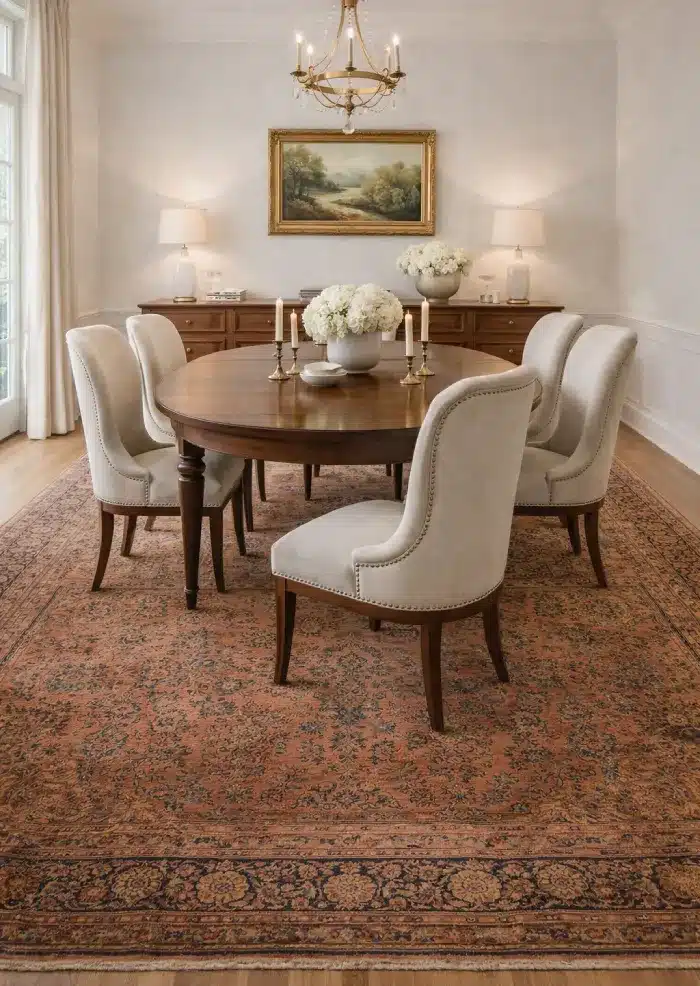
The Golden Rule of Dining Room Rug Sizing
Before we dive into specific measurements, you need to understand the one rule that governs all dining room rug decisions: the rule that, if followed, prevents nearly every sizing mistake.
The 24-Inch Rule
Here it is: Your rug must extend at least 24 inches (60 cm) beyond all edges of your dining table.
This 24-inch extension ensures that when someone pulls their chair out to sit down or pushes back after eating, all four chair legs remain on the rug. The average dining chair, when pulled out for comfortable seating, extends approximately 18-20 inches from the table edge. The 24-inch allowance provides a margin of safety beyond this minimum.
Let’s see this in practice:
- A 42″ × 72″ rectangular table needs a rug at least 90″ × 120″ (7.5′ × 10′)
- A 48″ diameter round table needs a rug at least 96″ (8′) in diameter
- A 36″ × 60″ table needs a rug at least 84″ × 108″ (7′ × 9′)
Why 24 Inches Is Non-Negotiable
Some guides suggest 18 inches is adequate. In my experience, 18 inches works only for people who barely scoot their chairs back, not realistic for most households. Here’s why I insist on 24 inches minimum:
Comfort: People push chairs back further than you expect, especially after a long meal. Adequate rug extension allows natural movement without restriction.
Stability: Chairs with legs half on and half off rugs are unstable. Someone pushing back abruptly could tip or catch the rug edge.
Visual proportions: Rugs with generous extensions look intentional and designed. Rugs with minimal clearance look like you bought the wrong size.
Future-proofing: Different chairs, different guests, and different furniture arrangements all benefit from the extra margin.
When to Exceed 24 Inches
Certain situations call for even more extension:
Formal dining rooms: In formal spaces where the rug defines the entire dining zone, 30-36 inches of extension creates more luxurious proportions.
Large tables: Bigger tables need proportionally more rug borders to look balanced. A 10-foot table with only 24 inches of visible rug on each side looks cramped.
High-traffic rooms: If the dining room sees regular traffic around the table, more rug prevents bare floor paths along the perimeter.
Sideboard inclusion: If you want a sideboard or buffet to also sit on the rug, you’ll need extension in that direction beyond the 24-inch chair minimum.
Dining Room Area Rug Size: Standard Dimensions Explained
Understanding standard rug sizes helps you match available options to your dining table requirements.
Standard Rectangular Rug Sizes
Most rugs come in these standard rectangular dimensions:
Size (feet) | Size (cm) | Best For |
5′ × 7′ | 152 × 213 | Small tables only (seats 4 max) |
6′ × 9′ | 183 × 274 | 36″ × 48″ to 36″ × 60″ tables |
8′ × 10′ | 244 × 305 | 42″ × 66″ to 48″ × 72″ tables |
9′ × 12′ | 274 × 366 | 48″ × 84″ to 54″ × 96″ tables |
10′ × 14′ | 305 × 427 | 60″ × 108″ tables and larger |
Important note: Hand-knotted and antique rugs often vary slightly from these exact dimensions. A rug sold as “9 × 12″ might actually measure 8’10” × 11’8″. Always verify actual dimensions before purchasing.
Standard Round Rug Sizes
Round rugs typically come in these diameters:
Diameter (feet) | Diameter (cm) | Best For |
6′ | 183 | 36″-42″ round tables |
8′ | 244 | 48″-54″ round tables |
10′ | 305 | 60″-72″ round tables |
12′ | 366 | Tables over 72″ |
Round rugs under 6 feet are generally too small for dining use; they’ll work as accents but won’t accommodate chair movement.
Standard Square Rug Sizes
Square rugs for square tables:
Size | Best For |
6′ × 6′ | 30″-36″ square tables |
8′ × 8′ | 42″-48″ square tables |
10′ × 10′ | 54″-60″ square tables |
Square rugs can also work under round tables in square rooms, providing complementary geometry.
Oval Rug Considerations
Oval rugs are less common but ideal for oval tables. If you can’t find an oval, use a rectangular rug the visual similarity is close enough that rectangular rugs work well under oval tables.

How to Size a Rug for a Dining Room: The Calculation Method
Rather than relying solely on general charts, learn how to size a rug for a dining room by calculating your exact requirements.
Step 1: Measure Your Table
Start with accurate table dimensions:
Rectangular tables: Measure length and width at the widest points (including any leaves if you use them regularly).
Round tables: Measure the diameter at the widest point.
Square tables: Measure one side at the widest point.
Oval tables: Measure both the length and width at their widest points.
Expandable tables: If you regularly use table leaves, measure with leaves in. It’s better to have excess rug when leaves are out than insufficient coverage when extended.
Step 2: Apply the 24-Inch Formula
Add 48 inches (4 feet) to each dimension to achieve 24 inches of extension on all sides:
Rectangular and oval tables:
- Minimum rug length = Table length + 48 inches
- Minimum rug width = Table width + 48 inches
Round tables:
- Minimum rug diameter = Table diameter + 48 inches
Square tables:
- Minimum rug size = Table side + 48 inches
Step 3: Calculate Examples
Example 1: Standard rectangular dining table
- Table dimensions: 42″ × 72″
- Minimum rug: 90″ × 120″ (7.5′ × 10′)
- Standard size to purchase: 8′ × 10′
Example 2: Round pedestal table
- Table diameter: 54″
- Minimum rug diameter: 102″ (8.5′)
- Standard size to purchase: 9′ or 10′ round
Example 3: Square farmhouse table
- Table dimensions: 48″ × 48″
- Minimum rug: 96″ × 96″ (8′ × 8′)
- Standard size to purchase: 8′ × 8′ or 8′ × 10′ rectangular
Step 4: Check Against Room Dimensions
Your calculated rug size must work within your room:
Leave floor borders: Aim for 18-24 inches of visible floor between rug edges and walls. Less looks cramped; more looks like the rug is floating.
Account for other furniture: If sideboards, buffets, or display cabinets are in the room, decide whether they should be on or off the rug.
Check traffic flow: Ensure the rug doesn’t extend into doorways or create traffic flow issues.
Step 5: The Tape Test
Before purchasing, verify your calculations:
- Use painter’s tape to outline the calculated rug dimensions on your floor
- Position your table and chairs within the taped area
- Do people sit down and push chairs back? Do all legs stay on the rug?
- Walk around the table, does the coverage feel adequate?
- Evaluate visual proportions from different room entry points
- Live with the tape outline for several days before purchasing
This simple test prevents expensive mistakes. What seems right on paper may feel different in actual space.
What Size Rug for Dining Room: Matching Tables to Rugs
Let’s get specific about what size rug for dining room scenarios based on common table sizes and seating capacities.
4-Person Dining Tables
Small tables seating four represent the minimum dining table size:
Typical dimensions: 36″ × 48″ to 42″ × 60″
Recommended rug sizes:
- Minimum: 6′ × 9′ (works for tables up to 36″ × 60″)
- Optimal: 8′ × 10′ (provides generous coverage and growth room)
Round 4-person tables (42″-48″ diameter):
- Minimum: 7′ round
- Optimal: 8′ round
Considerations: Many 4-person tables reside in eat-in kitchens or apartment dining areas where room size limits options. In tight spaces, a 6′ × 9′ may be all that fits just to ensure you’re getting the maximum chair coverage possible.
6-Person Dining Tables
The most common dining table size for family dining:
Typical dimensions: 42″ × 72″ to 48″ × 84″
Recommended rug sizes:
- Minimum: 8′ × 10′ (adequate for tables up to 48″ × 72″)
- Optimal: 9′ × 12′ (provides ideal proportions for most 6-person tables)
Round 6-person tables (54″-60″ diameter):
- Minimum: 8′ round
- Optimal: 9′ or 10′ round
Considerations: This is where the 8′ × 10′ versus 9′ × 12′ decision becomes important. The price difference is significant, but the 9′ × 12′ provides noticeably better proportions and chair coverage. If budget allows, invest in the larger size.
8-Person Dining Tables
Larger tables for family gatherings and entertaining:
Typical dimensions: 48″ × 96″ to 54″ × 108″
Recommended rug sizes:
- Minimum: 9′ × 12′ (works for tables up to 48″ × 96″)
- Optimal: 10′ × 14′ (provides proper proportions for larger tables)
Round 8-person tables (60″-72″ diameter):
- Minimum: 9′ round
- Optimal: 10′ or 12′ round
Considerations: Tables this size require substantial rugs that may need special ordering. The 10′ × 14′ size isn’t as commonly available as smaller sizes, so you may need to work with dealers who can source or custom-order appropriate dimensions.
10+ Person Dining Tables
Grand tables for large families or frequent entertaining:
Typical dimensions: 54″ × 120″ to 60″ × 144″
Recommended rug sizes:
- Minimum: 10′ × 14′
- Optimal: 12′ × 15′ or larger
Considerations: At these sizes, you’re entering custom territory. Work with rug dealers who can source oversized pieces or consider having rugs custom-made. Alternatively, some rooms use multiple coordinated rugs one under the table area, others under sideboards or secondary zones.
Dining Room Rug Size Chart: Quick Reference Guide
Here’s a comprehensive dining room rug size chart for quick reference:
Rectangular Tables
Table Size | Seats | Minimum Rug | Optimal Rug |
36″ × 48″ | 4 | 6′ × 9′ | 8′ × 10′ |
36″ × 60″ | 4-6 | 6′ × 9′ | 8′ × 10′ |
42″ × 66″ | 6 | 8′ × 10′ | 9′ × 12′ |
42″ × 72″ | 6 | 8′ × 10′ | 9′ × 12′ |
48″ × 84″ | 6-8 | 9′ × 12′ | 9′ × 12′ |
48″ × 96″ | 8 | 9′ × 12′ | 10′ × 14′ |
54″ × 108″ | 8-10 | 10′ × 14′ | 10′ × 14′ |
60″ × 120″ | 10+ | 10′ × 14′ | 12′ × 15′ |
Round Tables
Table Diameter | Seats | Minimum Rug | Optimal Rug |
36″ | 4 | 6′ round | 7′ round |
42″ | 4-5 | 7′ round | 8′ round |
48″ | 5-6 | 8′ round | 8′-9′ round |
54″ | 6-7 | 8′ round | 9′-10′ round |
60″ | 7-8 | 9′ round | 10′ round |
72″ | 8-10 | 10′ round | 12′ round |
Square Tables
Table Size | Seats | Minimum Rug | Optimal Rug |
36″ × 36″ | 4 | 6′ × 6′ | 7′ × 7′ |
42″ × 42″ | 4 | 7′ × 7′ | 8′ × 8′ |
48″ × 48″ | 4-6 | 8′ × 8′ | 8′ × 8′ or 9′ × 9′ |
54″ × 54″ | 6-8 | 9′ × 9′ | 10′ × 10′ |
60″ × 60″ | 8 | 10′ × 10′ | 10′ × 10′ or larger |
Matching Rug Shapes to Table Shapes

The geometry of your table influences which rug shapes work best though the rules aren’t as rigid as some suggest.
Rectangular Tables
Ideal rug shapes: Rectangular rugs work best, maintaining parallel lines and visual consistency.
Alternative options: Oval rugs can work under rectangular tables with rounded corners, creating a softer aesthetic.
What to avoid: Square rugs under long rectangular tables look disproportionate. Round rugs under rectangular tables rarely work visually.
Round Tables
Ideal rug shapes: Round rugs create perfect symmetry and emphasize the table’s circular form.
Alternative options: Square rugs under round tables can work well, especially in square rooms the geometric contrast creates intentional design tension.
What to avoid: Rectangular rugs under round tables can work in some contexts but often feel mismatched.
Oval Tables
Ideal rug shapes: Oval rugs are perfect but less commonly available. Rectangular rugs work well as the visual similarity is close enough.
Alternative options: Very large round rugs can work if the oval table isn’t extremely elongated.
What to avoid: Square rugs generally don’t complement oval table shapes.
Square Tables
Ideal rug shapes: Square rugs create perfect symmetry and balanced proportions.
Alternative options: Round rugs under square tables create interesting geometric interplay both centered shapes work together.
What to avoid: Rectangular rugs under square tables look unbalanced unless the room itself is rectangular, creating room-shape consistency.
Room Size and Layout Considerations
Your dining room’s dimensions and layout significantly impact rug sizing decisions.
Small Dining Rooms (Under 10′ × 10′)
Compact dining spaces require careful balance between adequate chair coverage and room proportions.
Challenges:
- Standard rug sizes may extend too close to walls
- Furniture may crowd the space
- Traffic flow around the table is limited
Strategies:
- Use the smallest table that meets your needs
- Accept minimum (6′ × 9′) rugs if that’s what fits
- Consider rugs that extend to within 6-12 inches of walls if necessary
- Prioritize chair coverage over visual floor borders
What works: A 36″ × 48″ table with a 6′ × 9′ rug in a 9′ × 10′ room
Medium Dining Rooms (10′ × 12′ to 12′ × 14′)
The most common dining room size, offering reasonable flexibility.
Opportunities:
- Room for standard table sizes (6-person)
- Standard rug sizes (8′ × 10′ to 9′ × 12′) fit well
- Adequate floor borders maintain good proportions
Strategies:
- Choose optimal rather than minimum rug sizes
- Maintain 18-24″ floor borders on all sides
- Consider including sideboards on the rug if desired
What works: A 42″ × 72″ table with an 8′ × 10′ or 9′ × 12′ rug in an 11′ × 13′ room
Large Dining Rooms (14′ × 16′ and larger)
Spacious dining rooms require proportionally larger elements to avoid looking sparse.
Challenges:
- Standard tables and rugs can look lost
- Filling the space without overcrowding
- Maintaining intimacy at the table despite room size
Strategies:
- Size up both table and rug proportionally
- Use rugs that extend well beyond the 24″ minimum
- Consider including secondary furniture (buffet, bar cart) on the rug
- A rug that’s “too big” usually looks better than one that’s too small
What works: A 48″ × 96″ table with a 10′ × 14′ rug in a 16′ × 18′ room
Open Floor Plan Dining Areas
When the dining area isn’t a separate room, the rug takes on additional importance.
Challenges:
- Defining the dining zone within larger space
- Coordinating with adjacent area rugs (living room, kitchen)
- No walls to help define boundaries
Strategies:
- Use the rug to clearly define dining territory
- Consider slightly larger than minimum sizes for better definition
- Ensure adequate separation from adjacent rugs (at least 18-24″)
- Coordinate colors and styles with other rugs in sight lines
What works: Clear visual separation between dining rug and living room rug, with enough floor visible between them to read as distinct zones.
Special Situations and Challenging Layouts
Not every dining room fits neat rectangular assumptions. Here’s how to handle unusual situations.
Expandable and Multi-Leaf Tables
Many families use table leaves for holidays and gatherings. How do you size for both configurations?
Option 1: Size for expanded use If you use leaves regularly (monthly or more), size the rug for the expanded table. When collapsed, you’ll have more rug borders than necessary but that’s preferable to insufficient coverage when extended.
Option 2: Size for everyday use If leaves come out only for holidays, size for regular use. Accept that on holidays, chair coverage may be compromised on the ends. Position end chairs carefully to maximize rug contact.
Option 3: Use rug rotation Some families own two rugs everyday and holiday sizes. This is expensive but provides optimal coverage for both scenarios.
Pedestal and Single-Column Tables
Tables with central pedestals rather than corner legs allow chairs to tuck more completely, potentially allowing slightly smaller rugs.
Adjustment: You might get away with 20-22 inches of extension rather than 24, since chairs can nestle closer to the table. However, I still recommend the standard 24 inches for comfort and aesthetics.
Bench Seating
If you use benches instead of individual chairs on one or both sides:
With backs: Treat benches like chairs you’ll push back to exit, requiring the same clearance.
Backless benches: May require slightly less clearance since you can swing legs over to exit. However, maintain at least 18 inches for visual proportions.
Built-In Banquette Seating
Booth-style built-in seating changes the equation:
Three open sides: Size the rug to accommodate the three sides where chairs pull out. The banquette side needs minimal rug extension.
Two open sides: If banquettes line two sides, focus rug sizing on the two open ends.
Corner banquettes: The rug only needs to accommodate movement on the open sides while still looking proportional to the whole table.
Mixed Dining/Living Spaces
In combined spaces without walls separating functions:
Strategy 1: Use a single large rug encompassing both areas works in small apartments but can look overwhelming.
Strategy 2: Use separate rugs with clear visual separation and maintain distinct zones.
Strategy 3: Use a dining rug only, leaving the living area without can work if the living area is on a different flooring material or has a natural boundary.
Material Considerations for Dining Room Rugs

Dining rooms present unique material requirements; these are high-spill, high-crumb environments.
Durability Requirements
Dining chairs cause significant wear:
Chair movement: Legs constantly push, pull, and pivot on the rug surface. Choose materials that resist abrasion.
Heavy traffic patterns: The same paths around the table see constant use. Materials should handle concentrated traffic.
Weight bearing: Full chairs with seated adults press significant weight through small leg contact points.
Best choices for durability: Flat-weave rugs, low-pile wool, and tightly woven constructions handle dining room demands better than plush, high-pile options.
Cleanability Priorities
Spills happen at dining tables:
Food drops: Crumbs, dropped food, and sauce splatters are inevitable, especially with children.
Beverage spills: Wine, juice, coffee, and water will contact the rug at some point.
Chair leg tracking: Chairs can track in dirt and debris.
Best choices for cleanability: Patterned rugs hide spots better than solids. Dark colors show crumbs but hide stains; light colors show crumbs clearly but may show stains more. Low-pile and flat-weave rugs are easier to clean than high-pile options. Indoor/outdoor rugs offer easy cleaning but may sacrifice aesthetics.
Material Recommendations
Best performers for dining rooms:
- Wool flat-weaves: Durable, cleanable, and available in beautiful designs
- Low-pile hand-knotted wool: Traditional beauty with practical performance
- Polypropylene: Budget-friendly, highly cleanable, but lacks natural fiber qualities
- Cotton flat-weaves: Washable (important advantage), but less durable than wool
Use with caution:
- High-pile/shag: Catches crumbs, hard to clean, unstable for chairs
- Silk: Too delicate for dining room abuse
- Antique/valuable rugs: Consider whether you can accept inevitable wear and staining
- Very light solids: Show every crumb and spill
Practical Pattern Guidance
Patterns serve functional purposes in dining rooms:
Multi-color patterns: Hide crumbs and minor stains between cleanings
Busy patterns: Camouflage wear patterns and spots
Darker borders: Hide the most common spill locations (table edges)
All-over patterns: Wear evenly across the surface
Common Dining Room Rug Mistakes
Learning from common errors helps you avoid them.
Mistake 1: Buying Too Small
The most frequent error rugs that work with chairs pushed in but fail when people sit.
How it happens: Underestimating how far chairs pull out, focusing on table dimensions only, or letting budget drive toward smaller options.
The consequence: Chairs slip off rug edges, creating stability issues and constant frustration.
Prevention: Follow the 24-inch rule without exception. Use the tape test before purchasing.
Mistake 2: Forgetting the Extension Requirement
Some people size based on just covering the table’s footprint.
How it happens: Not understanding that dining rooms have unique sizing requirements compared to other rooms.
The consequence: A rug that frames the table but fails its primary function of accommodating chair movement.
Prevention: Always add 48 inches to table dimensions this accounts for 24 inches on each side.
Mistake 3: Ignoring Room Proportions
A rug correctly sized for the table may be wrong for the room.
How it happens: Focusing only on table-to-rug proportions without considering the room as a whole.
The consequence: Rugs that extend too close to walls (cramped feeling) or leave too much bare floor (lost, floating appearance).
Prevention: Check calculated rug sizes against room dimensions. Maintain 18-24 inches of floor border where possible.
Mistake 4: Mismatched Shapes
Using rug shapes that conflict with table shapes.
How it happens: Buying what’s available or affordable without considering geometric compatibility.
The consequence: Visual discord that makes the space feel undesigned.
Prevention: Match rectangular rugs to rectangular tables, round to round, or use intentional contrast (square rugs under round tables in square rooms).
Mistake 5: Prioritizing Aesthetics Over Function
Choosing a beautiful rug that can’t handle dining room demands.
How it happens: Falling in love with a delicate antique silk rug or a high-pile shag.
The consequence: Damaged rugs, difficult cleaning, unstable furniture.
Prevention: Evaluate materials and construction for dining room suitability before falling in love with aesthetics.
Mistake 6: Forgetting About Table Leaves
Sizing for everyday table dimensions when leaves are used regularly.
How it happens: Measuring only the table’s collapsed state.
The consequence: Inadequate coverage when the table is extended for gatherings.
Prevention: If you use leaves monthly or more often, size for the extended table. If rarely, make a conscious decision about which configuration to prioritize.
Rug Care in Dining Environments
Dining rooms require attentive rug maintenance.
Daily/Weekly Maintenance
Vacuum regularly: Dining room rugs collect crumbs and debris quickly. Vacuum at least twice weekly, more with heavy use.
Spot clean immediately: Address spills the moment they happen. Blot (don’t rub), use appropriate cleaners for the rug material, and dry thoroughly.
Check chair glides: Ensure chair legs have appropriate protectors to minimize rug damage.
Rotate quarterly: Rotate the rug 180 degrees every three months to distribute wear evenly.
Professional Cleaning
Frequency: Professional cleaning every 12-18 months for active dining room rugs (more frequently than other room rugs due to higher soil levels).
Before events: Consider professional cleaning before major holidays or gatherings when the room will see heavy use.
After incidents: Major spills (red wine, oil, etc.) may require professional attention even if you’ve spot-cleaned.
Protection Strategies
Chair pads: Consider felt or rubber pads on chair legs to reduce abrasion.
Dining chair mats: In high-chair areas (for children), consider a clear mat over the rug for protection.
Immediate response kit: Keep appropriate stain removers accessible for quick response to spills.
Budget Considerations for Dining Room Rugs
Rug prices increase significantly with size dining room rugs represent substantial investments.
Understanding the Price Jump
Moving from 8′ × 10′ to 9′ × 12′ doesn’t increase the price by the square footage ratio. Larger rugs are disproportionately expensive because:
- Larger looms are less common
- Production time increases substantially
- Material requirements are higher
- Shipping and handling costs rise
Budget-Friendly Strategies
Machine-made options: Quality machine-made wool rugs cost a fraction of hand-knotted pieces while providing good performance.
Flat-weaves: Kilims and dhurries typically cost less than pile rugs at the same size while offering dining room-appropriate durability.
Indoor/outdoor rugs: Polypropylene rugs designed for outdoor use are highly cleanable and affordable, though they lack natural fiber aesthetics.
Wool blends: Rugs combining wool with synthetic fibers offer some natural fiber benefits at lower price points.
Investment Approach
If budget allows for a quality rug:
Choose durability: A well-made rug will outlast cheap alternatives, providing better long-term value.
Consider low-pile: Low-pile hand-knotted rugs cost less than thick piles at the same quality level and perform better in dining rooms anyway.
Buy appropriate quality for use: Dining rooms cause wear—save museum-quality antiques for lower-traffic spaces.
Conclusion: Choosing Your Perfect Dining Room Rug Size
Selecting the right dining room rug size comes down to one essential principle: the rug must accommodate chair movement. Apply the 24-inch rule without exception, extending your rug at least 24 inches beyond all edges of your dining table and you’ll avoid the frustrating functionality problems that plague wrong-sized dining rugs.
Beyond this functional foundation, remember these key principles:
Use the calculation method: Measure your table, add 48 inches to each dimension, then round up to the next available size. The dining room rug size chart in this guide provides quick reference for common scenarios.
Match shapes thoughtfully: Rectangular tables work with rectangular rugs, round with round—or create intentional geometric contrast that looks designed rather than accidental.
Consider your specific room: Your calculated rug size must work within your room’s dimensions. Maintain floor borders where possible, but prioritize chair coverage if you must compromise.
Choose appropriate materials: Dining rooms demand durability and cleanability. Save delicate rugs for other spaces.
Test before buying: Use the painter’s tape method to verify your calculations in your actual space before spending money.
The right dining room rug size transforms your eating space from merely functional to genuinely beautiful. It prevents embarrassing chair slippage, defines your dining zone with intention, and creates a foundation for memorable meals with family and friends. Whether you’re working with a compact apartment dining area or a grand formal room, the principles in this guide will help you make a choice that serves both beauty and function for years to come.
Take time to measure carefully, calculate precisely, and test thoroughly. A dining room rug is a significant investment to make sure it’s exactly right before you buy.
Frequently Asked Questions
Q: What is the minimum rug size for a dining room table?
A: The minimum rug size depends on your specific table dimensions, but the universal rule is that the rug must extend at least 24 inches (60 cm) beyond all edges of your table. This ensures that when guests pull their chairs out to sit, all four chair legs remain on the rug. To calculate your minimum size, add 48 inches (4 feet) to both your table’s length and width. For example, a typical 42″ × 72″ six-person table requires a minimum rug size of 90″ × 120″, which means an 8′ × 10′ rug. However, this is truly the minimum many design professionals recommend 9′ × 12′ for this table size to achieve better proportions and a more generous, comfortable feel. If you’re between sizes, always choose the larger option rather than the smaller one. An undersized dining room rug creates functional problems every time someone sits down or pushes back from the table.
Q: Can I use an 8′ × 10′ rug under a 6-person dining table?
A: Yes, an 8′ × 10′ rug works for most standard 6-person rectangular dining tables (typically measuring 42″ × 66″ to 42″ × 72″). This rug size provides approximately 22-27 inches of extension beyond the table on the shorter sides and 14-22 inches on the longer sides meeting or slightly exceeding the 24-inch minimum for chair movement. However, for tables at the larger end of the 6-person range (42″ × 72″ or 48″ × 72″), a 9′ × 12′ rug provides better proportions with 30+ inches of extension on all sides. The 9′ × 12′ creates a more luxurious, intentionally designed look and accommodates chair movement more generously. If your room can accommodate the larger size and your budget allows, the 9′ × 12′ is the optimal choice for 6-person tables. Reserve the 8′ × 10′ for smaller 6-person tables, 4-person tables, or rooms where space constraints require the smaller footprint.
Q: Should a dining room rug be round or rectangular?
A: The best rug shape for your dining room primarily depends on your table shape and secondarily on your room shape. Rectangular tables work best with rectangular rugs, creating visual harmony with parallel lines and consistent geometry. Round tables pair beautifully with round rugs, emphasizing the table’s circular form and creating perfect symmetry. Oval tables work with either oval rugs (if you can find them) or rectangular rugs, which are more commonly available. Square tables suit square rugs, though round rugs can also work, creating an interesting geometric dialogue. Room shape provides secondary guidance; a square room might benefit from a round rug’s softening effect, while a rectangular room reinforces rectangular rug logic. The key is ensuring that whatever shape you choose provides the necessary 24-inch extension for chair movement on all sides used for seating. Avoid combinations that create visual tension, like round rugs under rectangular tables or rectangular rugs under round tables (except for oval tables, which pair well with rectangles).
Q: How do I measure a dining room rug?
A: To measure for a dining room rug, follow this step-by-step process: First, measure your dining table at its widest points for rectangular tables, measure both length and width; for round tables, measure the diameter; for expandable tables, measure with leaves in if you use them regularly. Second, apply the 24-inch rule by adding 48 inches (4 feet) to each table dimension; this provides the 24-inch chair clearance needed on each side. Third, check your calculated dimensions against standard rug sizes and round up to the next available size. Fourth, verify that your calculated rug size works in your room by measuring from where the rug would end to the walls and aim for 18-24 inches of visible floor on all sides. Fifth, perform the tape test: use painter’s tape to outline your intended rug dimensions on the floor, position your table and chairs within the outline, have people sit and push back from the table to verify all chair legs stay within the tape, and live with the outline for several days before purchasing. This measurement process prevents expensive sizing mistakes and ensures your rug will function properly.
Q: What size rug do I need for a round dining table?
A: For round dining tables, calculate your rug size by adding 48 inches to your table’s diameter. A 48-inch round table (seats 4-6) requires a rug at least 96 inches (8 feet) in diameter. A 54-inch table (seats 6-7) needs a 9-foot or larger round rug. A 60-inch table (seats 7-8) requires a 10-foot round rug minimum. A 72-inch table (seats 8-10) needs a 10-12 foot round rug. Round rugs come in fewer standard sizes than rectangular rugs, with common options being 6′, 8′, 10′, and 12′ diameters. If your calculation falls between sizes, always round up to the larger option. If you can’t find a round rug in the size you need, you can alternatively use a square rug under a round table; this creates an intentional geometric contrast that works well, especially in square rooms. The key requirement remains the same regardless of shape: all chair legs must remain on the rug when chairs are pulled out for seating, which requires maintaining that 24-inch minimum extension beyond the table’s edge in all seating directions.
Standard Dining Room Rug Sizes Explained
EXCELLENTTrustindex verifies that the original source of the review is Google. I feel fortunate that we found Surena Rugs. We happened by after visiting a number of other rug stores, none of which had what we wanted in terms of size, color, style and price. Surena didn't have it either, but what set them apart was that Faye listened very carefully as we described our criteria and said that she would do her best to find a suitable solution. Not long after, she had two beautiful rugs for us to choose from, both of which worked well and were great values. We were very pleased with the entire process, and, Faye was wonderful to work with. Can't recommend them enough.Posted onTrustindex verifies that the original source of the review is Google. Faye was wonderful to work with. She has beautiful rugs and was patient in helping me find just the right ones for my space! Could not be happier with the service and quality of the rugs at Surena.Posted onTrustindex verifies that the original source of the review is Google. Faye is a delight to work with and has an amazing selection of rugs. I would 100% recommend Surena Rugs to anyone looking for beautiful rugs.Posted onTrustindex verifies that the original source of the review is Google. Wonderful establishment, kind and knowledgeable owner, beautiful quality rugs. A+, strongly recommendedPosted onTrustindex verifies that the original source of the review is Google. As an interior designer, who has worked with this family for many years , I can say Surena Rugs is reputable and dependable, with excellent quality and pricing. They offer a wide selection of antique rugs, as well as the beautiful light oushak rugs we are seeing in the market today. Highly recommended.Posted onTrustindex verifies that the original source of the review is Google. Three years ago I was in Atlanta and bought a New Zealand hand-knotted wool rug for my dining room. Moe, the owner of Surena Rugs, was very kind and patient as I was choosing the perfect rug for my home. I had the rug shipped to me (I live in Northern California). It arrived promptly and the rug is perfect in my dining room. After not being able to go to Atlanta and our most recent trip being cancelled, I reached out to Surena Rugs to find a runner that would complement the dining room rug. Faye, the other owner of Surena Rugs, was so helpful. She went beyond my expectations to help me. I explained to her what I wanted and sent her a photo of my dining room rug. After looking at rugs at her showroom, she sent me a photo of the runner she thought would work. The rug looked perfect. Faye shipped the rug to me, it arrived and is absolutely perfect! I highly recommend Surena Rugs. The craftsmanship and quality of the rugs are impeccable.What is even more special is the excellent service you will receive when looking and purchasing the perfect rug(s) for your home.Posted onTrustindex verifies that the original source of the review is Google. Best fine rug shopping! I purchase a very large handmade rug and they were very patient and accommodating me in the narrowing down, selection process. The rug was a great value and reasonable price and I get lots of compliments on it. It has held up very well over the last 18 months - we will have the rug for many many years to come. I highly recommend checking out their selection of rugs and customer experience! Will not disappoint!!!Posted onTrustindex verifies that the original source of the review is Google. I highly recommend SURENA rugs! I found the perfect rug (size, color, look) and Faye went to great lengths to make sure I found the one! Thank you Faye + team!! ❤️Posted onTrustindex verifies that the original source of the review is Google. Surena Rugs has the best collection! Faye has great taste and is there to help you pick the perfect rug to match your home. Highly recommend!Posted onTrustindex verifies that the original source of the review is Google. What an amazing store, the owner is very friendly and knowledgeable. Me and my wife came to buy a rug from here and we got an amazing fair price compared to other places! Highly recommend if you’re looking for a great quality, old or new rug!Verified by TrustindexTrustindex verified badge is the Universal Symbol of Trust. Only the greatest companies can get the verified badge who has a review score above 4.5, based on customer reviews over the past 12 months. Get a Quote
Surena Rugs is a trusted provider offering expert dining room rug size guidance in the United States. With over two decades of dedicated experience in the rug industry, we understand the importance of proper measurements—ensuring your rug extends at least 24 inches beyond the table on all sides for seamless chair movement. Our expertise in matching rug dimensions to dining spaces has earned us a 5-star rating on Google from happy customers nationwide. From intimate dining areas to grand entertaining spaces, we invite you to explore our range of sizes and create a beautiful, functional dining room that brings everyone together.
Written by Mohsen Sadeghzade, Interior Design Consultant & Rug Specialist