
5 Signs of a Quality Handmade Rug: Expert Guide to Authentic Craftsmanship
TLDR – Quick Answers:
- What’s the most reliable quality indicator? Check the back – handmade rugs show irregular knot patterns and slight color variations.
- How many knots indicate quality? 120-400 knots per square inch is excellent; above 600 often signals machine production.
- What materials mean authentic quality? Hand-spun wool with natural lanolin, silk highlights, and cotton foundations in traditional pieces.
- Why do quality rugs have imperfections? Human weavers create natural variations that machines can’t replicate – perfect patterns suggest automation.
The Atlanta market has exploded with both authentic treasures and sophisticated fakes. Quality handmade rugs represent generations of skill, but telling the difference requires knowing exactly what separates a $500 machine-made piece from a $5,000 authentic Persian.
What I call the Five-Point Authentication System has helped me evaluate thousands of rugs over the years. These aren’t academic theories – they’re field-tested methods that reveal a rug’s true story within minutes.
The Knot Density Test: Why More Isn’t Always Better
Knot density alone doesn’t determine quality – but the pattern of knots tells the entire story. I’ve seen clients obsess over knot counts while missing the real indicators staring them in the face.
Here’s what most dealers won’t tell you: authentic handmade rugs show knot count variations across the piece. A skilled weaver might achieve 200 knots per square inch in detailed areas, then drop to 150 in solid color sections. Machine-made rugs maintain exactly 180 knots throughout – that consistency is actually the red flag.
💡 Key Insight: Turn the rug over and look for knot irregularities. Handmade pieces show slightly different knot sizes, occasional color bleeds, and human inconsistencies that machines can’t replicate.
The sweet spot for quality handmade rugs sits between 120-400 knots per square inch. Below 120, you’re looking at tribal or nomadic pieces (which can be spectacular but serve different purposes). Above 600, you’re often seeing machine production trying to mimic fine hand-knotting.
I remember examining a “silk Kashan” with claimed 800 knots per square inch. The dealer insisted it was handmade, but every knot was identical in size and tension. No human weaver maintains that level of mechanical consistency. Real silk Kashans from master weavers show beautiful variations – tighter knots around intricate florals, looser knots in background areas.
✅ Knot Density Checklist:
- □ Count knots in a one-inch square (use a ruler and magnifying glass)
- □ Check multiple areas – handmade pieces vary by 10-20%
- □ Look for knot irregularities on the back side
- □ Be suspicious of perfectly uniform knot patterns
- □ Ask for the specific knot count and verify it yourself
Material Authenticity: The Touch and Burn Test
Your hands can detect quality faster than your eyes. Authentic wool from highland sheep carries natural lanolin that creates a distinctive feel – slightly oily, resilient, with a satisfying weight.
Machine-spun wool feels processed, almost sterile. Hand-spun wool has character – slight thickness variations, natural oils, and what I call “grip.” When you run your fingers through quality wool pile, it springs back. Synthetic fibers feel slick and lifeless.
The burn test reveals everything about fiber content, though obviously use this sparingly on valuable pieces. Natural wool burns slowly with a protein smell (like burning hair), leaving soft ash. Synthetics melt into hard beads and smell chemical.
⚠️ Common Mistake: Assuming silk highlights mean higher quality. Many machine-made rugs add artificial silk (actually mercerized cotton) to mimic premium pieces. Real silk has a distinctive cool touch and creates rainbow-like color shifts in different light.
Cotton foundations appear in most authentic Persian and Turkish rugs. Quality cotton warps feel substantial but flexible – never brittle or chemically treated. Jute foundations usually indicate machine production or lower-grade pieces.
One client brought me a “handmade Afghan” that felt wrong immediately. The wool had zero natural oils, felt uniformly processed, and the cotton foundation was bleach-white instead of the natural cream color traditional weavers use. Three minutes of examination revealed machine production masquerading as tribal craftsmanship.
Need help authenticating a piece you’re considering? Get in Touch Now!
The Back Side Story: What the Underside Reveals
The back of a rug never lies. This is where machine production reveals itself most clearly, and where handmade authenticity shines through every imperfection.
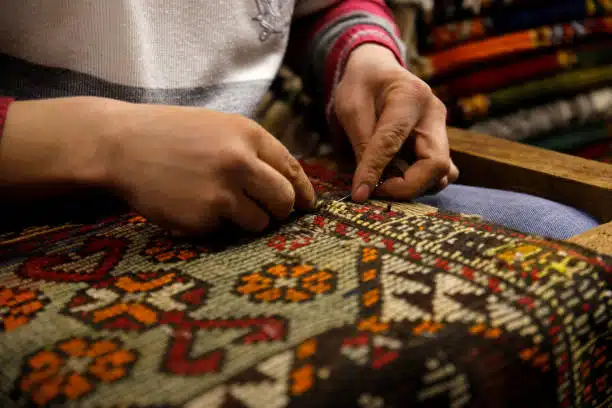
Flip any rug over and look at the pattern clarity on the reverse. Handmade rugs show the design almost as clearly on the back as the front – each knot creates a tiny dot of color that builds the pattern. Machine-made rugs show blurry, indistinct patterns because the pile is created differently.
Look for what I call “weaver’s signatures” – the small inconsistencies that prove human hands created each knot. Color bleeding where dyes mixed slightly. Knot tension variations. Occasional thread ends where the weaver started new yarn. These aren’t flaws – they’re authentication marks.
📋 Back Side Inspection Process:
- Pattern Clarity: Can you clearly see the design? Sharp pattern lines indicate hand-knotting.
- Knot Irregularities: Look for size variations and slight color bleeds between adjacent knots.
- Foundation Inspection: Check warp and weft threads for natural variations and proper tension.
- Edge Examination: Hand-finished edges show slight irregularities machine edges lack.
Machine-made backs look too perfect. Even high-end machine production maintains uniform knot size, perfect color separation, and mechanical precision. Human weavers can’t achieve that level of consistency – and that’s exactly what makes their work valuable.
I’ve examined thousands of pieces, and the back side reveals authenticity within seconds. Recently, a dealer tried to convince me that a perfectly uniform rug was handmade because it had “natural wool.” The back side showed machine precision that no human weaver could maintain across 60 square feet.
Intentional Imperfections: Why Perfect Is Suspicious
Perfect rugs are perfectly suspicious. Master weavers intentionally include small variations because perfection belongs to the divine, not human hands. This philosophy creates the most reliable authentication method most buyers ignore.
Look for what tribal weavers call “the weaver’s touch” – subtle variations that occur naturally during months of hand-knotting. A border pattern might shift slightly. Colors might vary between morning and evening work sessions. The pile height might show microscopic differences.
Machine-made rugs achieve perfection humans can’t match. Every motif appears identical. Colors maintain exact consistency. Pattern spacing never varies. This mechanical precision actually decreases value in the world of authentic handmade rugs.
💡 Key Insight: High-quality handmade rugs often include deliberate imperfections called “Persian flaws” – small pattern breaks that honor the belief that only divine creation should be perfect.
I’ve seen collectors reject authentic tribal pieces because they weren’t “perfect” enough, then buy machine-made copies because they looked more “professional.” Understanding that imperfection indicates authenticity transforms how you evaluate handmade rugs.
The most valuable handmade rug I ever handled – a 16th-century silk Isfahan worth more than most houses – had at least twenty visible “flaws.” Slight color variations. One border flower with an extra petal. A tiny section where the weaver ran out of one dye batch. These variations told the story of its creation and proved its authenticity beyond doubt.
Age and Patina: Reading the Story in the Wool
Authentic patina takes decades to develop and can’t be artificially replicated convincingly. Learning to read age signs in wool and dyes separates serious collectors from casual buyers.
Natural aging creates what I call “lived-in beauty” – gentle color softening, pile compression in traffic areas, and the distinctive sheen that develops from years of natural oils and careful use. Artificial aging techniques create harsh color washing, uniform wear patterns, and chemical odors.
Real patina develops unevenly. High-traffic areas show more wear. Colors exposed to natural light fade differently than protected sections. Authentic age creates character that enhances rather than diminishes value.
⚠️ Common Mistake: Confusing artificial aging with natural patina. Chemically aged rugs smell harsh, show uniform wear patterns, and often have brittle fibers. Natural aging creates soft color transitions and maintains fiber integrity.
Dye characteristics reveal age and authenticity immediately. Natural dyes from madder root, indigo, and cochineal age gracefully, developing rich depth and complexity. Chemical dyes fade harshly or maintain unnaturally bright colors despite claimed age.
One collector brought me a “100-year-old Heriz” with suspiciously bright reds and uniform wear patterns. The dealer claimed it was “well-preserved,” but natural reds from madder root would have developed burgundy undertones after a century. Chemical analysis confirmed synthetic dyes applied to artificially aged wool.
The abrash effect – natural color variations within single dye lots – provides another authenticity marker. Traditional weavers used dye batches that varied slightly, creating subtle color shifts across large areas. Machine production uses chemically consistent dyes that eliminate this natural variation.
Cost Reality Check: Why Authentic Craftsmanship Costs More
Quality handmade rugs represent months of skilled labor – and pricing reflects that reality. Understanding cost structures helps identify authentic pieces and avoid overpriced machine-made goods.
A skilled weaver produces roughly one square foot of quality hand-knotted rug per week. Factor in materials, design complexity, and finishing work, and authentic pieces carry substantial production costs before any dealer markup.
I use what I call the Labor Reality Formula: multiply the rug’s square footage by 40-60 hours of skilled weaving time. Add premium materials and traditional finishing. The result explains why authentic pieces cost significantly more than machine alternatives.
✅ Fair Pricing Indicators:
- □ Hand-knotted wool rugs: $15-50+ per square foot for quality pieces
- □ Silk accents add 30-50% to base pricing
- □ Antique and semi-antique pieces command premium pricing
- □ Tribal and nomadic pieces often cost less but offer unique authenticity
- □ Suspiciously low prices usually indicate machine production
Beware of “too good to be true” pricing on claimed handmade pieces. A genuine 9×12 hand-knotted Persian rug represents 1,500+ hours of skilled labor. Pricing that doesn’t reflect this investment usually indicates machine production or misrepresentation.
Recently, a client found a “handmade Persian” advertised for $800 in a 10×14 size. Basic math revealed the impossibility – authentic production costs alone would exceed that price. Examination confirmed machine production with artificially aged appearance.
At Surena Rugs, we’ve built our reputation on honest authentication and fair pricing. Our clients know they’re investing in authentic craftsmanship with transparent provenance and realistic pricing that reflects true production costs.
Want expert authentication on a piece you’re considering? Get in Touch Now!
Frequently Asked Questions
How Can You Tell if a Handmade Rug Is High Quality?
High-quality handmade rugs reveal themselves through consistent inconsistency – the natural variations that prove human craftsmanship. Start by examining the back side where the pattern should appear nearly as clearly as the front.
The most reliable indicators include irregular knot patterns, natural color variations within single dye lots (called abrash), and the distinctive feel of hand-spun wool with natural lanolin. Quality pieces show knot density between 120-400 per square inch, with variations across different pattern areas rather than mechanical uniformity.
Material authenticity matters tremendously. Hand-spun wool feels resilient and slightly oily from natural lanolin, while machine-spun wool feels processed and sterile. Natural dyes age gracefully, developing rich depth over time, while synthetic dyes fade harshly or maintain unnaturally bright colors.
Look for what I call “weaver’s signatures” – small imperfections that actually increase value by proving human creation. These include slight color bleeds, occasional knot tension variations, and minor pattern irregularities that machines cannot replicate.
What Is the Difference Between a Quality Rug and a Low-Quality One?
The difference lies primarily in materials, construction method, and the time invested in creation. Quality rugs use premium materials like hand-spun wool with natural lanolin, authentic silk highlights, and traditional cotton or wool foundations.
Construction reveals everything about quality. Hand-knotted rugs show clear pattern definition on both sides, with each individual knot creating a tiny dot of color. Machine-made rugs display blurry, indistinct patterns on the reverse side because the pile is created through tufting or weaving rather than individual knotting.
Low-quality pieces often use synthetic materials that feel slick and lifeless, maintain unnaturally uniform appearance, and show mechanical precision that eliminates the natural variations human weavers create. They frequently feature chemical dyes that age poorly and artificial materials that don’t develop the rich patina authentic pieces acquire over time.
Quality pieces justify their higher cost through durability that spans generations, authentic cultural heritage, and the investment of hundreds of hours of skilled craftsmanship. The price differential reflects the reality of human labor versus machine production – there’s simply no way to hand-knot a quality rug without significant time and skill investment.
How Do You Check the Knot Density of a Handmade Rug?
Checking knot density requires examining the rug’s back side with a ruler and magnifying glass for accurate measurement. Count the knots within a precise one-inch square, then multiply by the width to get knots per square inch (KPSI).
However, knot density alone doesn’t determine quality – the pattern of density variations tells the real story. Authentic handmade rugs show knot count differences between detailed and solid areas, typically varying by 10-20% across the piece. Machine-made rugs maintain exactly consistent knot counts throughout.
Look for specific density ranges that indicate different quality levels: tribal and nomadic pieces often feature 60-120 KPSI, city workshop rugs typically show 120-400 KPSI, and extremely fine pieces may reach 400-600 KPSI. Densities above 600 often indicate machine production attempting to mimic hand-knotting.
The key insight most buyers miss is that knot irregularities prove authenticity more than absolute density numbers. Check multiple areas across the rug – handmade pieces show natural variations where weavers adjusted technique for different pattern elements, while machine-made pieces maintain mechanical consistency that no human weaver can achieve.
What Materials Are Used in High-Quality Handmade Rugs?
High-quality handmade rugs primarily use hand-spun wool from highland sheep, which retains natural lanolin that creates the distinctive resilient feel and natural luster that synthetic materials cannot replicate. This wool develops rich patina over decades of use.
Authentic silk accents appear in premium pieces, providing luminous highlights that shift color in different lighting conditions. Real silk feels cool to the touch and creates rainbow-like reflections, while artificial silk (often mercerized cotton) lacks these characteristics and feels warmer.
Foundation materials typically include cotton warps and wefts in Persian and Turkish pieces, chosen for strength and stability. Quality cotton foundations feel substantial but flexible, appearing in natural cream colors rather than bleached white. Some tribal pieces use wool foundations throughout, creating different handling characteristics.
Natural dyes from traditional sources like madder root (reds), indigo (blues), and cochineal (crimsons) age gracefully over time, developing complex undertones and rich depth. These materials cost significantly more than synthetic alternatives but create the authentic color development that collectors value in antique and semi-antique pieces.
How Do You Spot a Fake or Machine-Made Rug Sold as Handmade?
Machine-made rugs reveal themselves through mechanical perfection that no human weaver can achieve. The back side shows the clearest evidence – machine production creates blurry, indistinct pattern images while hand-knotting produces sharp, clear pattern definition on both sides.
Look for suspicious uniformity in knot size, pattern spacing, and color consistency. Machine-made rugs maintain exactly identical motifs throughout, while handmade pieces show natural variations where human weavers adapted to pattern requirements or material changes during the months-long creation process.
Material characteristics expose fakes immediately. Machine-spun wool feels processed and sterile without the natural oils and resilience of hand-spun fibers. Synthetic foundations appear unnaturally white instead of the cream-colored cotton traditional weavers prefer, and artificial aging creates harsh chemical odors.
Pricing provides the most obvious red flag – authentic hand-knotted rugs require hundreds of hours of skilled labor that cannot be economically replicated at machine-production prices. If a claimed “handmade” piece costs significantly less than the labor investment would justify, it’s almost certainly machine-made regardless of dealer claims. Trust the math more than the marketing.
Your Next Steps
Look, I’ve given you twenty-five years of authentication knowledge in one article. If you’re feeling overwhelmed, here’s exactly where to start:
- Master the back-side examination – This single skill eliminates 90% of fake handmade rugs instantly
- Trust your hands over your eyes – Authentic materials feel different, and that touch test never lies
- Remember the Labor Reality Formula – If the price seems too good for months of skilled handwork, it probably is
The Atlanta market offers incredible authentic pieces alongside sophisticated fakes. The difference is knowing what to look for – and now you do.
Don’t let dealers rush you through examinations. Quality handmade rugs represent significant investments that deserve thorough authentication. Take your time, use these five signs, and trust what you’ve learned here.
Read More: Why Persian Rugs Are Expensive: 8 Factors That Drive Premium Prices
