
How to Choose the Right Rug Size for Your Living Room
TLDR – Quick Answers:
- What size rug for a standard living room? 8×10 feet minimum – front legs of all furniture should sit on the rug.
- Should rugs go under all furniture? Front legs minimum, all legs preferred – creates visual unity and proper proportions.
- Common living room rug sizes in cm? 152x244cm (5×8), 183x274cm (6×9), 244x305cm (8×10), 274x366cm (9×12).
- Bigger or smaller when unsure? Always go bigger – undersized rugs make rooms look choppy and disconnected.
Living Room Rug Size Cheatsheet: The 18-Inch Rule
Here’s what 25 years in the rug business has taught me: most people choose rugs that are too small. I call this the Living Room Float Syndrome – when your rug sits in the middle of the room like an island, making everything look disconnected.
The golden rule? Leave 18 inches of bare floor around the perimeter of your rug. This creates proper visual balance and makes your room feel intentionally designed, not accidentally furnished.
💡 Key Insight: A rug that’s too small makes expensive furniture look cheap. A properly sized rug makes budget furniture look expensive.
Here’s your quick sizing guide based on room dimensions:
- 10×12 ft room: 6×9 ft rug (minimum) or 8×10 ft (preferred)
- 12×15 ft room: 8×10 ft rug (minimum) or 9×12 ft (ideal)
- 14×17 ft room: 9×12 ft rug (minimum) or 10×14 ft (luxury)
- 16×20+ ft room: 10×14 ft or larger custom sizes
But room size is only part of the equation. Your furniture arrangement determines everything.
Furniture Layout Planning: The Front Legs Formula
This is where most people get confused. They think rug sizing is about floor space, but it’s really about furniture relationships. Your rug needs to create visual connections between pieces, not just cover the floor.
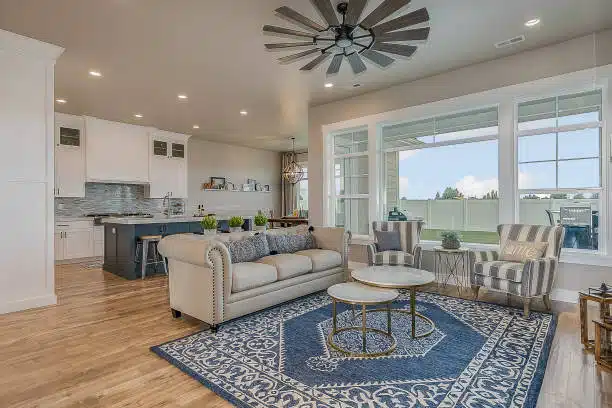
I use what I call the Front Legs Formula: at minimum, the front legs of your sofa and chairs should sit on the rug. Ideally, all four legs of each piece should be on the rug.
✅ Furniture Placement Checklist:
- □ Front legs of sofa ON the rug (non-negotiable)
- □ Front legs of accent chairs ON the rug
- □ Coffee table centered with all legs ON the rug
- □ Side tables either fully ON or fully OFF (never half-on)
- □ 6-12 inches of rug extending beyond furniture edges
The worst mistake? Having all furniture sitting around the rug like it’s a museum exhibit. This creates what designers call ‘conversation pit syndrome’ – everything looks separate and uncomfortable.
One of my Atlanta clients had a beautiful sectional sofa but chose a 6×9 rug for her 15×18 living room. Only the coffee table sat on the rug. The room felt choppy and cold. We switched to a 9×12, got the front legs of the sectional on the rug, and suddenly the space felt 50% larger and infinitely more welcoming.
Measuring Your Living Room Correctly: Beyond Length and Width
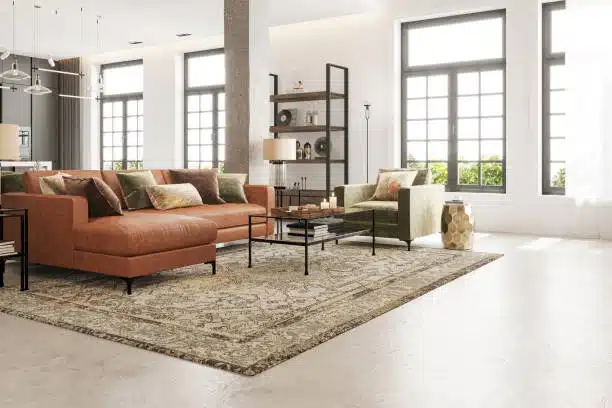
Here’s what nobody tells first-time rug buyers: you’re not measuring the room, you’re measuring the furniture arrangement. I’ve seen people buy perfect-sized rugs for their room dimensions that look terrible because they didn’t account for their actual layout.
Start by measuring your conversation area – the space where your main seating and coffee table sit. Add 18-24 inches on all sides. That’s your target rug size, not your room dimensions.
📋 Step-by-Step Measuring:
- Map Your Furniture: Sketch your room with current furniture placement
- Mark the Conversation Zone: Draw a rectangle around your main seating area
- Add Buffer Space: Extend 18-24 inches beyond this rectangle on all sides
- Check Room Proportions: Ensure 18+ inches of bare floor remains around the rug perimeter
- Test with Tape: Use painter’s tape to outline your target rug size on the floor
That tape trick is gold. I learned it from a client who’d been burned twice by online rug purchases. She now tapes every rug size before buying, and she hasn’t made a sizing mistake since.
Common Sizing Mistakes That Ruin Beautiful Rooms
After 25 years, I can spot these mistakes from across a showroom. Here are the biggest rug sizing disasters I see repeatedly:
⚠️ Common Mistake: Choosing a 5×8 rug for anything larger than a 10×12 room. This size only works in small apartments or bedroom seating areas.
Mistake #1: The Postage Stamp Syndrome
Choosing a rug that’s dramatically too small for the space. I see 5×8 rugs in 16×18 rooms constantly. It makes everything look disconnected and the room feel larger in a bad way – like a furniture showroom rather than a home.
Mistake #2: The Half-On, Half-Off Disaster
Having some furniture legs on the rug and some off. This creates visual tension and makes pieces look unstable. Either commit to having furniture fully on the rug or fully off – never half-and-half.
Mistake #3: The Coffee Table Island
Only putting the coffee table on the rug while the seating floats around it. This destroys the conversation grouping and makes the coffee table look like it’s on a different plane from the rest of the furniture.
Mistake #4: The Wall-to-Wall Fear
Being afraid to go large because it ‘takes up too much room.’ A properly sized rug actually makes rooms feel larger by creating visual unity. Small rugs chop up the space and make it feel cramped.
Confused about your specific layout? Get in Touch Now! for personalized sizing advice.
Standard Rug Sizes in CM: International Sizing Guide
Since many of our clients work with metric measurements, here’s your complete conversion guide for standard living room rug sizes:
| Size (Feet) | Size (CM) | Best For | Room Size |
|---|---|---|---|
| 5×8 ft | 152×244 cm | Small apartments, bedroom seating | Up to 3×4 meters |
| 6×9 ft | 183×274 cm | Compact living rooms, studios | 3×4 to 3.5×4.5 meters |
| 8×10 ft | 244×305 cm | Standard living rooms | 3.5×4.5 to 4×5 meters |
| 9×12 ft | 274×366 cm | Large living rooms, open concepts | 4×5 to 5×6 meters |
| 10×14 ft | 305×427 cm | Grand spaces, luxury homes | 5×6+ meters |
Pro tip: When ordering from international suppliers, always confirm whether dimensions include fringe. Hand-knotted rugs often have 2-4 inches of fringe on each end, which affects your actual coverage area.
The most popular size in our Atlanta showroom? 8×10 feet (244×305 cm). It works in 70% of American living rooms and creates proper furniture relationships without overwhelming the space.
Sectional Sofa Rug Rules: The L-Shape Challenge
Sectionals create unique rug challenges due to their L-shaped footprint. Standard rectangular rugs often don’t align properly with sectional arrangements, leaving awkward gaps or overhangs.
The Sectional Sizing Formula: Measure the full footprint of your sectional (including the chaise) and add 18 inches on all exposed sides. For most sectionals, this means:
- Small sectionals (7-8 ft total): 8×10 ft rug minimum
- Large sectionals (9-10 ft total): 9×12 ft rug minimum
- Extra-large sectionals (11+ ft): 10×14 ft or custom size
💪 Pro Tip: For L-shaped sectionals, position the rug so the longer side of the sectional aligns with the longer dimension of the rug. This creates better visual balance.
Common sectional mistake: Centering the rug under the corner of the sectional. This leaves the chaise hanging off and creates an unbalanced look. Instead, position the rug so both the main section and chaise have proper coverage.
Small Living Room Solutions: Making Compact Spaces Work
Small living rooms require different rug strategies. You can’t just scale down the rules – you need to optimize for the space you have.
For rooms under 10×12 feet: Go with a 6×9 rug and use the All-On or All-Off Rule. Either get all furniture legs on the rug, or keep everything off and use the rug as a center anchor piece.
The Small Space Hack: Instead of trying to fit everything on the rug, focus on creating one strong visual anchor. A 6×9 rug under just the coffee table, with seating arranged around it, can actually make a small room feel larger than trying to squeeze everything onto an undersized rug.
💡 Key Insight: In small spaces, a properly sized rug that only covers the center conversation area often works better than a too-small rug trying to include all furniture.
Apartment dwellers: Consider layering if you’re dealing with rental restrictions. A smaller high-quality rug layered over a larger, budget-friendly jute or sisal rug can give you the coverage you need while keeping your investment piece portable.
Professional Placement Rules: The Designer’s Secret Formula
Here’s what interior designers know that most homeowners don’t: rug placement is about creating visual weight balance, not just covering floor space.
The Weight Distribution Principle: Your rug should anchor the heaviest piece in the room (usually the sofa) while connecting it visually to other elements. This creates what I call ‘visual gravity’ – everything feels like it belongs together.
Professional placement guidelines:
- Sofa placement: Front legs on the rug, positioned 6-12 inches from the rug’s front edge
- Coffee table: Centered on the rug with equal space on all sides
- Accent chairs: Front legs on the rug, angled slightly toward the sofa
- Side tables: Either fully on or fully off the rug – never straddling the edge
The floating furniture mistake: Having all furniture sitting around the rug creates what designers call ‘conversation pit syndrome.’ Everything looks separate and uninviting. Get at least the front legs of your main pieces on the rug to create visual connection.
Budget Considerations by Size: Investment vs. Coverage
Let’s talk money. Rug pricing increases exponentially with size, and choosing the wrong size can waste thousands of dollars.
Size vs. Price Reality Check:
- 6×9 ft rug: Budget range $800-3,500
- 8×10 ft rug: Budget range $1,200-5,500
- 9×12 ft rug: Budget range $1,800-8,000
- 10×14 ft rug: Budget range $2,800-12,000+
The Size Investment Strategy: It’s better to buy a correctly sized rug in a simpler design than a smaller rug in your dream pattern. A properly sized rug elevates your entire room, while a beautiful but too-small rug can make the space feel awkward no matter how gorgeous the design.
⚠️ Common Mistake: Buying a smaller size to save money, then feeling unsatisfied with how the room looks. You’ll likely end up replacing it within two years.
Smart budget approach: Consider quality vintage or semi-antique pieces in larger sizes. At Surena Rugs, we often recommend vintage Persian rugs that offer exceptional value in 8×10 and 9×12 sizes compared to new production pieces.
Visual Tricks for Any Space: Designer Illusions
Want to make a room feel larger? Use a rug with an all-over pattern rather than a strong central medallion. All-over patterns create visual continuity that makes the space feel more expansive.
Want to make a room feel cozier? Choose a rug with a strong central design or medallion pattern. This creates a focal point that draws the eye inward and makes large spaces feel more intimate.
The Color Psychology Factor: Light-colored rugs make spaces feel larger but show dirt more easily. Dark rugs make spaces feel cozier but can make small rooms feel cramped. Medium tones offer the best balance for most living situations.
💪 Pro Tip: If you’re torn between two sizes, go larger. In 25 years, I’ve never had a client regret choosing a bigger rug, but I’ve had dozens regret going too small.
The Border Trick: Rugs with defined borders create stronger visual boundaries and work better in formal spaces. Borderless or all-over patterns create softer transitions and work better in casual or open-concept homes.
Testing Rugs Before You Buy: The Smart Shopper’s Strategy
Here’s something most rug retailers won’t tell you: you should never buy a large rug sight unseen. Colors, textures, and scale can look completely different in your home than in photos or showrooms.
The Smart Testing Approach:
- Use painter’s tape to outline your target rug size on the floor
- Live with the outline for a week – notice how traffic patterns work around it
- Request samples of your top 3 choices to see in your actual lighting
- Consider in-home trials if available (Surena Rugs offers this service for Atlanta-area clients)
Lighting makes a huge difference. A rug that looks perfect under bright showroom lights might look completely different under your home’s warm LED lighting or natural daylight from specific windows.
✅ Pre-Purchase Checklist:
- □ Measured furniture arrangement, not just room
- □ Tested size with painter’s tape outline
- □ Confirmed all main furniture front legs will be on rug
- □ Verified 18+ inches of bare floor around perimeter
- □ Considered lighting conditions in your space
- □ Factored in door swing clearances
The door clearance issue: Don’t forget to check that your rug won’t interfere with door swings. I’ve seen beautiful installations ruined because the rug bunches up when doors open.
High-End Rug Considerations: Investment Pieces
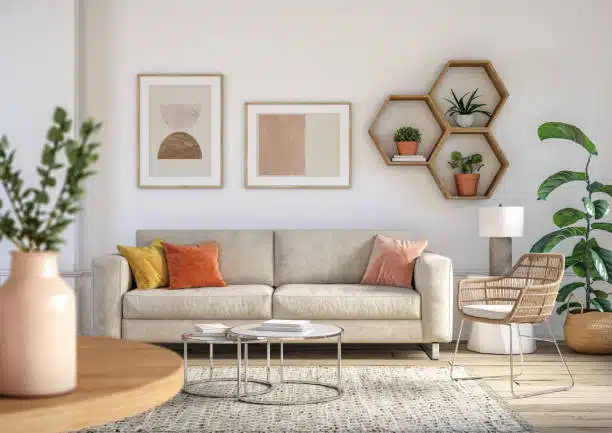
When you’re investing in hand-knotted Persian, Turkish, or other luxury rugs, sizing becomes even more critical. These pieces are meant to last generations, so getting the size wrong is a costly mistake.
Investment-grade sizing strategy: Go larger than you think you need. A 9×12 investment rug can move with you to different homes and adapt to various furniture arrangements. An 8×10 is more limiting long-term.
The appreciation factor: Larger sizes in hand-knotted rugs hold their value better than smaller sizes. 9×12 and larger rugs are always in demand, while 5×8 and 6×9 sizes have more limited markets.
Considering an investment piece? Get in Touch Now! for personalized guidance on sizing and selection.
Antique and vintage considerations: Older rugs may have irregular dimensions due to handmade construction and age-related shrinkage. Always verify actual measurements, not catalog dimensions, when buying antique pieces.
Frequently Asked Questions
What Size Rug Is Best for a Standard Living Room?
For most standard living rooms (12×15 feet), an 8×10-foot rug is the minimum size that will look properly proportioned. However, a 9×12 foot rug is often the better choice if your budget allows.
Here’s the reality most websites won’t tell you: the ‘standard’ living room varies dramatically. What matters more than your room size is your furniture arrangement. I’ve worked with clients who have 14×16 rooms but their conversation area only occupies a 10×12 space because of the room’s layout. In that case, an 8×10 rug works perfectly.
The key principle is the front legs rule: at minimum, the front legs of your sofa and main chairs should sit on the rug. Ideally, all four legs of your major pieces should be on the rug. This typically requires an 8×10 as the absolute minimum for most furniture arrangements.
My recommendation? Measure your actual conversation area (the space occupied by your sofa, coffee table, and main chairs), then add 18-24 inches on all sides. That’s your target rug size, regardless of what the internet says about ‘standard’ room dimensions.
Should a Living Room Rug Go Under All Furniture or Just the Front Legs?
Front legs minimum, all legs preferred – that’s the professional standard. Having just the front legs of your main furniture on the rug creates visual connection while keeping costs manageable. Having all four legs creates the most cohesive, high-end look.
The worst mistake I see constantly is having all furniture sitting around the rug like it’s a museum exhibit. This creates what designers call ‘floating furniture syndrome’ – everything looks disconnected and the conversation area feels awkward. Your rug should anchor your furniture grouping, not sit in the middle like an island.
Here’s the hierarchy of what works: the Best option is to place all the major pieces (sofa, chairs, coffee table) on the rug. Good option is front legs only of seating with the coffee table fully on the rug. Acceptable option in small spaces is just the coffee table on the rug with seating arranged around it.
What never works is the half-on, half-off approach – having some legs on the rug and some off the same piece of furniture. This creates visual tension and makes pieces look unstable. Commit to either on or off for each piece.
What Are the Most Common Rug Sizes in CM for Living Rooms?
The most popular living room rug sizes in centimeters are: 244×305 cm (8×10 ft), 274×366 cm (9×12 ft), and 183×274 cm (6×9 ft). These three sizes handle about 80% of residential living room applications.
Size breakdown by room type: For compact living rooms or apartments, 183×274 cm (6×9 ft) works well. For standard family living rooms, 244×305 cm (8×10 ft) is the sweet spot. For large or open-concept spaces, 274×366 cm (9×12 ft) or larger creates proper proportions.
International sizing note: When ordering from overseas suppliers, always confirm whether measurements include fringe. Hand-knotted rugs often have 5-10 cm of fringe on each end, which affects your actual floor coverage. A 244×305 cm rug with 10 cm fringe on each end gives you about 224×285 cm of actual rug surface.
The sizing sweet spot: In my experience, 244×305 cm (8×10 ft) offers the best value proposition – large enough for proper furniture relationships in most homes, but not so large that it becomes prohibitively expensive in quality pieces.
How Do You Measure Your Living Room to Find the Right Rug Size?
Don’t measure your room – measure your furniture arrangement.This is the mistake that leads to 90% of sizing disasters. You’re not trying to cover floor space; you’re trying to create visual connection between your furniture pieces.
Step-by-step measuring process: First, sketch your room with your current furniture placement. Then draw a rectangle around your main conversation area (sofa, coffee table, main chairs). Add 18-24 inches beyond this rectangle on all sides. That’s your target rug size. Finally, check that this leaves at least 18 inches of bare floor around the rug perimeter.
The tape test is crucial: Use painter’s tape to outline your target rug size on the floor and live with it for a week. You’ll quickly see if the proportions feel right and if the size works with your daily traffic patterns. I learned this trick from a client who’d been burned twice by online purchases.
Common measuring mistakes: Don’t forget to account for door swings, heating vents, and furniture that might move (like dining chairs that pull out). I’ve seen beautiful installations ruined because the rug interferes with normal room function.
Is It Better to Go Bigger or Smaller When Choosing a Living Room Rug?
Always go bigger when in doubt. In 25 years of rug consulting, I’ve never had a client regret choosing a larger rug, but I’ve had dozens regret going too small. A rug that’s too small makes expensive furniture look cheap, while a properly sized rug makes budget furniture look expensive.
Why bigger works better: Larger rugs create visual unity and make rooms feel more spacious, not smaller. Small rugs chop up the space and create visual fragmentation. When people say a large rug will ‘overwhelm’ their room, they’re usually thinking about wall-to-wall carpet, not a properly proportioned area rug.
The economics of sizing: Here’s something most people don’t consider – you’ll likely end up replacing an undersized rug within two years because it never looks quite right. It’s more cost-effective to buy the right size once than to buy twice. Plus, larger sizes in quality rugs hold their value better for resale.
The only exception: In very small apartments (under 400 square feet), sometimes a smaller rug used as a center anchor piece works better than trying to fit everything on an undersized rug. But even then, don’t go smaller than 6×9 feet unless you’re working with a truly tiny space.
Your Rug Sizing Action Plan
Look, I’ve given you a lot of information here. But here’s the truth: most people who read this will bookmark it and never actually measure their space. Don’t be that person.
If you only do three things from this guide:
- Use the tape test this weekend – outline your target rug size with painter’s tape and live with it for a week. This single step prevents 90% of sizing mistakes.
- Follow the front legs rule – at minimum, get the front legs of your main seating on the rug. This creates the visual connection that makes everything look intentional.
- When in doubt, go bigger – I’ve never had a client regret choosing a larger rug, but countless have regretted going too small.
Everything else is optimization. Start with proper sizing, and your room will look more expensive and feel more welcoming, regardless of your budget or style preferences.
The perfect rug size isn’t about following rules – it’s about creating a space where you actually want to spend time. Get the proportions right, and everything else falls into place.
Read More: 5 Signs of a Quality Handmade Rug: Expert Guide to Authentic Craftsmanship
