Caucasian Rugs History: Ancient Traditions, Symbols & Antique Value
The story of Caucasian rugs history stretches back centuries, weaving together the cultural threads of mountain villages, tribal traditions, and artistic innovation across one of the world’s most diverse regions. Nestled between the Black Sea and the Caspian Sea, the Caucasus Mountains have been home to weavers who created some of the most distinctive and sought-after carpets in the world. These textiles are far more than floor coverings; they’re cultural artifacts that tell stories of migration, faith, protection, and daily life. Understanding the rich tapestry of Caucasian rug-making reveals not just the evolution of a craft, but the soul of entire communities who poured their identity into every knot and pattern.
The Ancient Origins of Caucasian Carpet Weaving
The roots of carpet weaving in the Caucasus region extend deep into antiquity, with archaeological evidence suggesting textile production existed here as early as the Bronze Age. The strategic location of the Caucasus serving as a crossroads between Europe and Asia meant that weaving traditions absorbed influences from Persian, Turkish, Central Asian, and even Chinese sources while developing their own unmistakable character.
Early Caucasian weavers worked primarily with wool from local sheep, which thrived in the mountainous terrain. The harsh climate and rugged landscape shaped not only the materials available but also the practical needs that drove rug production. These early textiles served essential functions: insulation against cold stone floors, portable wealth for nomadic groups, and dowry items that represented family honor and prosperity.
By the medieval period, distinct regional styles had begun to emerge across the Caucasus. The geographic isolation of mountain valleys meant that individual villages often developed their own design vocabularies, passed down through generations of weavers. This isolation created remarkable diversity within a relatively compact geographic area, with each district producing rugs that experts can identify at a glance.
Understanding Antique Caucasian Rug Characteristics and Value
What sets an antique Caucasian rug apart from other Oriental carpets is a combination of bold geometric patterns, vibrant natural dyes, and a distinctive weaving technique. These rugs typically feature a robust, low pile created with Turkish (symmetrical) knots, resulting in durable textiles that could withstand daily use in harsh mountain environments.
Antique Caucasian rugs from the 18th and 19th centuries are particularly prized by collectors today. These pieces showcase exceptional craftsmanship before the introduction of synthetic dyes and commercial production methods altered traditional practices. The natural dyes used in antique examples derived from madder root for reds, indigo for blues, and various plant sources for yellows and browns have aged beautifully, developing the sought-after patina that collectors call “abrash.”
The value of these antique pieces has steadily increased over the past century. A genuine antique Caucasian rug in good condition can command prices ranging from several thousand to hundreds of thousands of dollars, depending on age, condition, rarity, and artistic merit. Museum-quality examples from the 17th or early 18th centuries are exceptionally rare and valuable, often reserved for institutional collections.
Determining authenticity requires expertise, as the popularity of Caucasian designs has led to countless reproductions and inspired pieces. Genuine antiques display certain characteristics: wool that has acquired a lustrous sheen with age, natural dye colors that have mellowed harmoniously, hand-spun yarn with slight irregularities, and construction details that reflect pre-industrial techniques.
Caucasian Rug Types: A Regional Journey
The Caucasus region encompasses a remarkable diversity of ethnic groups and geographic subregions, each contributing distinct styles to the broader tradition. Understanding Caucasian rug types means taking a journey through mountain villages and tribal territories, each with its own design language.
Kazak Rugs: Bold Geometry from the South
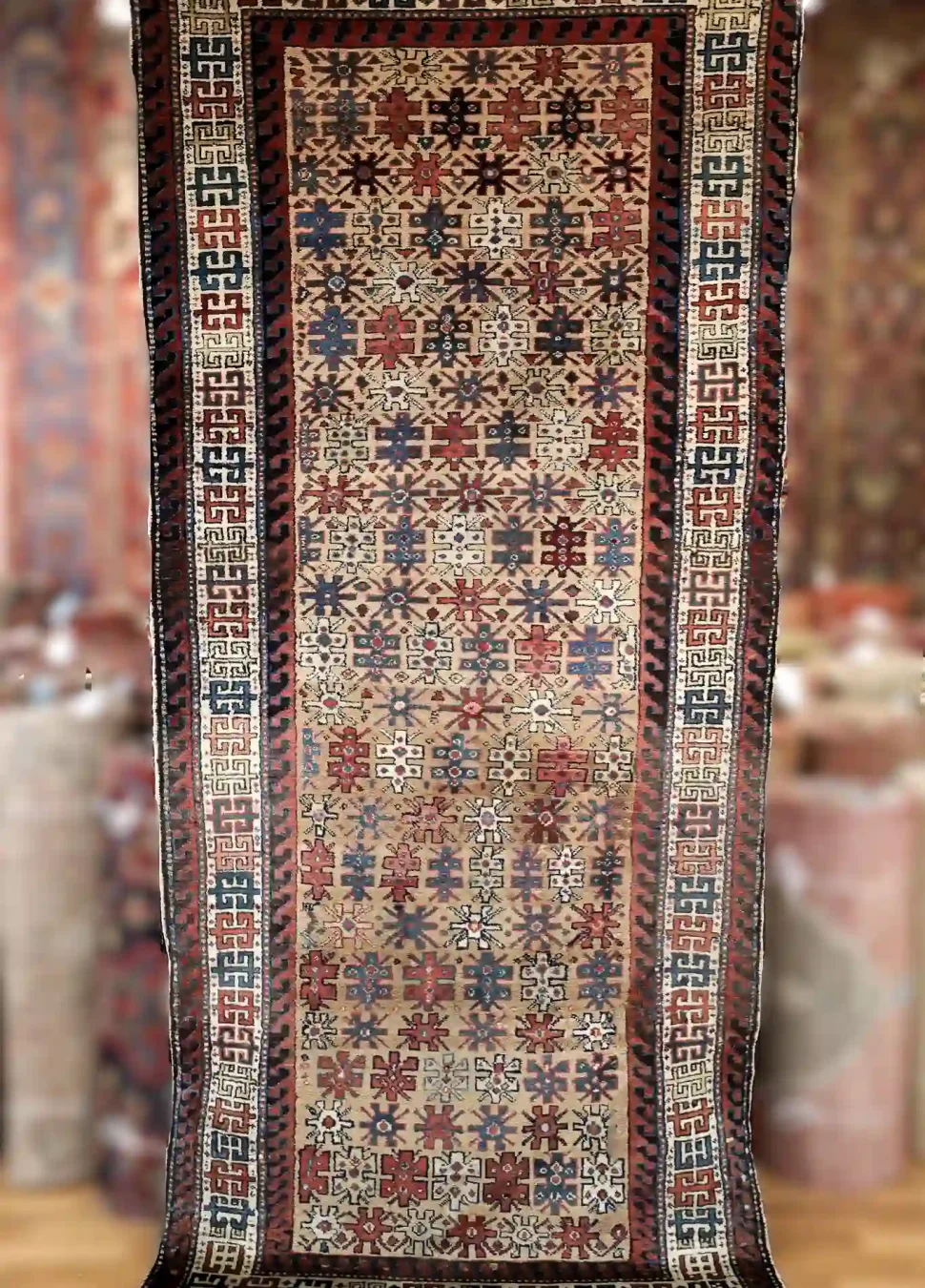
Kazak rugs, woven primarily in the southern Caucasus (in what is now Armenia and parts of Azerbaijan), are perhaps the most recognizable Caucasian type. These rugs feature large-scale geometric medallions, bold borders, and a color palette dominated by rich reds, deep blues, and ivory. The designs are spacious and uncluttered, with significant areas of open field that allow the eye to rest.
The wool used in Kazak rugs is notably lustrous and thick, creating a substantial pile that feels luxurious underfoot. Traditional Kazak patterns include the “sunburst” medallion, large shield-shaped central motifs, and distinctive hooked polygons that seem to march across the field in rhythmic procession.
Shirvan Rugs: Precision and Detail
Moving east to the Shirvan district along the Caspian Sea coast, we encounter rugs of an entirely different character. Shirvan rugs feature finer weaving, smaller-scale patterns, and more intricate detailing than their Kazak cousins. The designs often incorporate multiple borders, sometimes as many as seven or eight each filled with different geometric motifs.
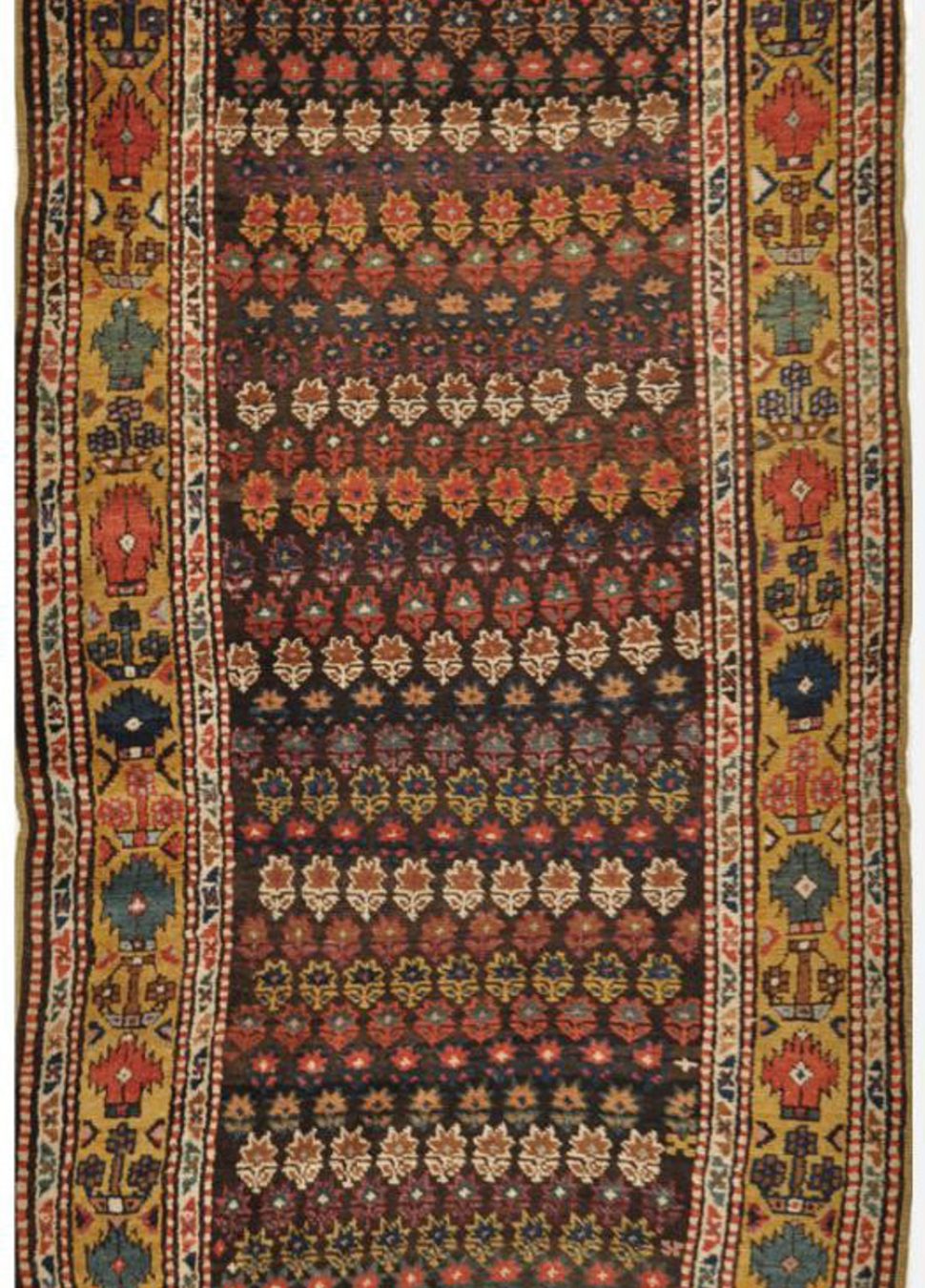
Common Shirvan patterns include repeating boteh (paisley) motifs, small geometric flowers, and distinctive octagonal medallions. The color palette tends toward darker, more subdued tones, with navy blues, deep reds, and warm browns predominating. Antique Shirvan prayer rugs, with their distinctive mihrab (prayer niche) design, are particularly sought after by collectors.
Kuba Rugs: Floral Geometry
The Kuba region in northeastern Azerbaijan produced rugs that bridge the gap between the bold geometry typical of Caucasian weaving and the more floral designs associated with Persian carpets. Kuba rugs often feature stylized floral elements arranged in geometric frameworks, creating a unique hybrid aesthetic.
These rugs typically display excellent technical quality, with fine knotting that allows for greater design detail. The color palette is varied and vibrant, often including bright yellows, vivid blues, and warm terracotta tones alongside the traditional reds and navy. Kuba weavers were known for their “Khila” pattern, a distinctive design featuring geometric medallions on a diagonal grid.
Daghestan Rugs: Prayer Rugs of the Northeast
From the mountainous Daghestan region come some of the finest prayer rugs in the Caucasian tradition. These pieces are characterized by their smaller size, precise weaving, and distinctive prayer niche designs. The mihrab is often filled with elaborate geometric patterns and framed by multiple decorative borders.
Daghestan rugs frequently incorporate stylized architectural elements, creating the impression of looking through ornate doorways or windows. The technical quality is generally exceptional, with high knot counts and meticulous attention to detail. These rugs reflect the deeply Islamic character of the region, with designs that served both practical and spiritual purposes.
Karabagh Rugs: French Influence Meets Caucasian Tradition
The Karabagh region produced rugs that stand somewhat apart from other Caucasian types, showing clear influence from both Persian and, surprisingly, French design traditions. In the 19th century, French merchants became involved in rug production in this area, introducing floral patterns and design sensibilities that merged with local geometric traditions.
Karabagh rugs often feature elaborate floral bouquets, herati patterns, and flowing vine designs rendered in a distinctly Caucasian geometric interpretation. The color palette tends to be softer and more varied than in other Caucasian types, with rose, salmon pink, and soft greens appearing alongside traditional colors.

The Sacred Language: Caucasian Rug Symbols and Their Meanings
One of the most fascinating aspects of Caucasian rugs history is the rich symbolic vocabulary embedded in traditional designs. Caucasian rug symbols served multiple functions: they protected against evil, brought blessings, communicated tribal identity, and recorded important events. Understanding these symbols transforms a rug from a beautiful object into a readable text.
Protection Symbols: Guardians Against Evil
Many Caucasian rug symbols functioned as talismans against misfortune. The “evil eye” motif—often appearing as a diamond or hexagon with contrasting colors—was believed to deflect malevolent gazes and protect the household. These symbols might be woven into borders, scattered across the field, or incorporated into larger medallion designs.
Ram’s horn motifs, rendered as spiraling hooks or curled elements, represented fertility, male power, and protection. These ancient symbols, which predate Islamic influence in the region, connect Caucasian weaving to prehistoric traditions found throughout Central Asia and the Near East. The horns might appear as independent elements or form part of larger composite designs.
Nature and Fertility Symbols
Despite the geometric abstraction typical of Caucasian rugs, many designs have their origins in natural forms. Stylized trees of life often reduced to simple branching forms or vertical elements with symmetrical offshoots represented the connection between earth and heaven, as well as fertility and growth.
Boteh motifs, which we recognize as the paisley pattern, originated as stylized floral or leaf forms. In Caucasian rugs, these are often rendered as geometric teardrop shapes, sometimes with a hooked or pointed end. When repeated across a field, they create a sense of abundance and natural plenty.
Star and cross motifs appear frequently, often filling the centers of medallions or forming repeating patterns. While these geometric forms are visually simple, they carried multiple layers of meaning: stars represented divine light and cosmic order, while crosses (predating Christian influence in many cases) symbolized the four cardinal directions and the union of earthly and heavenly realms.
Tribal Identity and Status Markers
Certain motifs served as signatures, identifying the tribal group or specific village where a rug was woven. The “running dog” border pattern, a repeated angular motif that resembles interlocking geometric creatures, was favored by certain weaving groups. The presence or absence of specific design elements could signal clan affiliation, much like a family crest.
Size and complexity of patterns could also indicate status. Larger, more elaborate medallions might be reserved for important families, while the quality of materials and precision of weaving reflected the weaver’s skill and the family’s resources. In some traditions, particularly fine rugs were woven only for important life events: weddings, births, or religious observances.
Reading the Borders
The borders of Caucasian rugs deserve special attention, as they often contain concentrated symbolic information. Multiple borders, each with different motifs, created a protective frame around the central field. Common border patterns include:
The “Kufic border,” featuring angular geometric elements derived from early Islamic calligraphy, brought the blessing of sacred text without depicting actual letters. The “cloudband border,” with its characteristic S-curved elements, originated in Chinese art and traveled westward along the Silk Road. The “crab border,” “wine glass border,” and “running water border” each carried their own meanings and regional associations.
The Golden Age: 18th and 19th Century Production

The 18th and 19th centuries represent the golden age of Caucasian rug weaving, when traditional village production reached its artistic and technical peak. During this period, rugs were still woven primarily for local use and as dowry items, with only limited production for external markets. This meant that weavers maintained creative freedom, working within established traditions while allowing for individual expression.
The political landscape of the Caucasus during this era was complex, with various Persian, Ottoman, and Russian powers competing for influence. Despite or perhaps because of this political instability, local weaving traditions remained strong. The relative isolation of mountain villages meant that outside influences filtered in slowly, allowing regional styles to develop and mature.
Natural dyes during this period were at their finest. Weavers had centuries of accumulated knowledge about extracting and fixing colors from local plants, minerals, and insects. The famous “Caucasian red” derived from madder root, when properly prepared and fixed with the right mordants, produced colors ranging from warm orange-red to deep burgundy. These natural dyes aged gracefully, developing subtle variations (abrash) that added depth and visual interest.
The social context of weaving was equally important. Rug-making was women’s work, passed from mother to daughter through hands-on apprenticeship. Young girls learned by watching, then by helping prepare materials, and finally by weaving under supervision. By the time a woman married, she would have woven her own dowry rugs, demonstrating both her skill and her readiness for household responsibility.
These dowry rugs often incorporated special motifs or personal elements a weaver might include symbols representing her hopes for her future family, or subtly alter traditional patterns to create something uniquely hers. This personal investment is part of what gives antique Caucasian rugs their vitality and emotional resonance.
The Commercial Period and Changing Traditions
The late 19th and early 20th centuries brought dramatic changes to Caucasian rug weaving. As European and American demand for Oriental carpets increased, commercial interests began organizing and standardizing production. What had been a village craft became increasingly industrialized, with significant consequences for both the rugs and the weavers.
Russian expansion into the Caucasus, completed by the mid-19th century, opened the region to commercial exploitation. Merchant houses established workshops, provided materials to village weavers, and dictated designs that would appeal to Western markets. While this created economic opportunities, it also diluted the authentic regional character of many rugs.
The introduction of synthetic dyes, beginning in the 1860s, represented perhaps the most visible change. Early synthetic dyes (aniline dyes) were notoriously unstable; they ran when wet, faded unpredictably, and lacked the subtle variations of natural colors. Rugs from this “transitional period” (roughly 1870-1920) often mix natural and synthetic dyes, creating jarring color combinations that make them less desirable to collectors.
However, not all commercial-period changes were negative. Increased demand meant more people could make a living from weaving, and some merchant houses maintained high standards, insisting on quality materials and traditional designs. Certain workshops became known for excellence, and rugs from these sources remain highly collectible.
The early 20th century also saw the first serious Western scholarship on Caucasian rugs. Collectors and researchers began documenting regional styles, recording weaving techniques, and preserving information about traditional symbols and patterns. This scholarly attention helped establish Caucasian rugs as serious art objects worthy of museum collections.
Revolution, Soviet Era, and Near Extinction
The Russian Revolution of 1917 and subsequent Soviet control of the Caucasus brought seismic changes to traditional weaving. The Soviet system initially attempted to preserve and promote traditional crafts as expressions of national cultures within the Soviet framework. State-run workshops were established, elderly master weavers were documented, and rug-weaving was maintained as a viable occupation.
However, Soviet-era production operated under entirely different principles than traditional village weaving. Designs were standardized by committees, materials were provided by the state, and production quotas replaced individual creativity. While technical quality could be high, these rugs lacked the spontaneity and personal expression of earlier examples.
The symbolism in Caucasian rug symbols also underwent revision during the Soviet period. Traditional religious or tribal motifs were sometimes suppressed or reinterpreted as purely decorative elements. Weavers learned to work within constraints, sometimes subtly maintaining traditional elements while outwardly conforming to official requirements.
The later Soviet period (1960s-1980s) saw diminished emphasis on traditional crafts as industrialization and urbanization pulled young people away from villages. Rug weaving, like many traditional skills, became increasingly relegated to elderly practitioners in remote areas. Knowledge that had been passed down for generations was in danger of dying with its last keepers.
The collapse of the Soviet Union in 1991 brought new challenges. Economic instability made it difficult for weavers to obtain materials or find markets for their work. Ethnic conflicts in the region disrupted communities and displaced populations, further endangering weaving traditions. By the early 21st century, authentic traditional Caucasian rug weaving had nearly disappeared.
Revival and Contemporary Preservation
The past few decades have seen renewed interest in preserving and reviving authentic Caucasian weaving traditions. This revival comes from multiple directions: collectors seeking to document and preserve antique rugs, cultural organizations working to maintain traditional crafts, and commercial enterprises recognizing market demand for authentic handwoven carpets.
In Azerbaijan, Armenia, and Georgia, cultural heritage programs have worked to identify remaining traditional weavers and document their knowledge. Master weavers have been encouraged to teach younger generations, with the goal of maintaining unbroken chains of transmission. Some programs have had success attracting young people by framing traditional weaving as both cultural preservation and economic opportunity.
The revival of natural dye techniques has been particularly important. Researchers have worked with elderly dyers to record traditional recipes and methods, then teach these techniques to new generations. Modern weavers are rediscovering the richness and subtlety of colors derived from madder, indigo, weld, and other traditional sources. This return to natural dyes produces rugs that are not mere copies of antiques but authentic expressions of traditional practices.
Museums and private collectors have played crucial roles in preservation by maintaining collections that serve as reference materials for contemporary weavers. Detailed documentation of antique rugs including technical analysis, dye studies, and structural examination provides a knowledge base that would otherwise have been lost.
Contemporary rug production falls into several categories. Some workshops focus on creating accurate reproductions of antique designs for the decorative market. Others encourage weavers to work within traditional frameworks while allowing for personal creativity and contemporary color palettes. A few high-end workshops collaborate with master weavers to create new rugs using entirely traditional materials and techniques, resulting in pieces that are contemporary in creation date but traditional in every other sense.
Collecting and Appreciating Caucasian Rugs Today
For collectors and enthusiasts, understanding Caucasian rugs history enhances appreciation and informs purchasing decisions. The market for Caucasian rugs is complex, with genuine antiques commanding premium prices while reproductions and decorative pieces are available at various price points.
When evaluating an antique Caucasian rug, several factors determine quality and value. Age is important but not everything a mediocre rug from 1850 is not necessarily more desirable than an exceptional piece from 1920. Condition matters enormously: original pile height, intact borders, minimal repairs, and stable colors all enhance value. Rarity plays a role, with unusual designs or rugs from less-common weaving areas commanding premiums.
Provenance can significantly impact value. A rug with documented history perhaps purchased from a known collection or appearing in published references carries additional cachet. Exhibition history, scholarly documentation, and inclusion in important collections all enhance a rug’s standing in the market.
For those beginning to collect or simply wishing to own a beautiful Caucasian-style rug, several options exist. Antique rugs in lower price ranges typically have condition issues, worn pile, repairs, or fading but can still be beautiful and serviceable. Semi-antique rugs (generally 50-100 years old) often offer good value, particularly pieces from the 1920s-1950s that predate synthetic dyes but are more available than 19th-century examples.
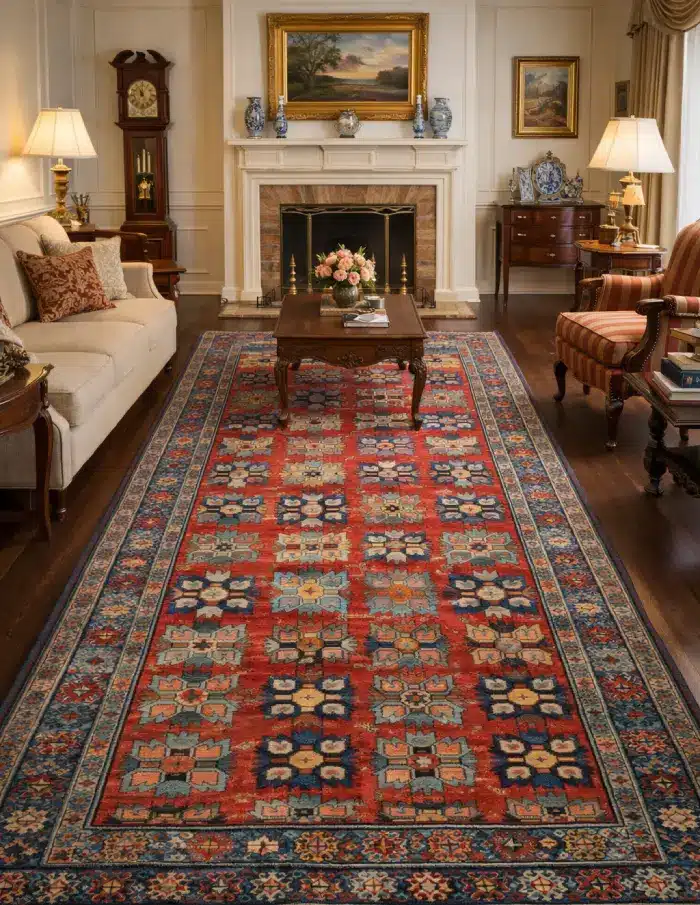
Contemporary reproductions serve the market well for those who want the Caucasian aesthetic without the investment or fragility of an antique. The best contemporary pieces use hand-spun wool and natural dyes, resulting in rugs that honor traditional methods. These can be beautiful, durable, and reasonably priced, though they lack the historical significance and investment potential of genuine antiques.
Caring for a Caucasian rug, whether antique or contemporary, involves regular maintenance and appropriate use. Rotation prevents uneven wear, regular vacuuming (without beater bars on antiques) removes damaging grit, and professional cleaning every few years maintains the textile’s health. Antique rugs should be kept away from direct sunlight, which fades natural dyes, and should not be placed in high-traffic areas where wear will damage fragile fibers.
The Cultural Significance Beyond Decoration

Understanding Caucasian rugs history means recognizing these textiles as cultural documents, not merely decorative objects. Each rug represents hours of skilled labor; a medium-sized rug might require six months to a year of full-time work. This investment of time and skill was deemed worthwhile because rugs served crucial social and cultural functions.
In traditional Caucasian society, rugs were a primary form of wealth, particularly for women. A woman’s dowry rugs represented her family’s resources and her own skill. Throughout her life, she might weave additional rugs to mark important occasions or to provide for her children’s future dowries. Rugs could be sold or traded in times of need, serving as a form of wealth that was portable and held value across political and cultural boundaries.
The designs and symbols in these rugs connected individuals to larger communities and historical traditions. Working within established design frameworks linked a weaver to her ancestors and to the collective wisdom of her people. Yet within these frameworks, there was room for creativity and personal expression, a balance between individual and community that characterized much traditional art.
Rugs also served as teaching tools, with patterns and techniques transmitted through observation and practice. A young girl learning to weave absorbed not just technical skills but cultural knowledge encoded in the symbols and patterns. This knowledge included practical information (which plants produced which colors, how different wools behaved), cultural history (what designs were associated with her village or tribe), and symbolic meanings that connected physical objects to spiritual beliefs.
The decline of traditional weaving represents more than the loss of a craft it’s the loss of entire systems of knowledge, social practice, and cultural transmission. This is why preservation efforts matter, even in a world where mass-produced carpets are readily available and inexpensive. What’s being preserved is not just the ability to make rugs, but the cultural knowledge embedded in the practice.
Investment Perspectives and Market Dynamics
From an investment standpoint, high-quality antique Caucasian rugs have proven to be solid long-term holdings. Unlike many decorative arts, fine Oriental rugs have maintained value through economic cycles and changing tastes. The best Caucasian rugs from the 18th and 19th centuries have consistently appreciated, with museum-quality examples seeing substantial price increases over the past several decades.
Several factors support the investment case for Caucasian rugs. Supply is inherently limited, no more genuine 19th-century Caucasian rugs are being made, and existing examples are subject to deterioration and loss. Demand remains strong from collectors, decorators, and museums worldwide. As wealth expands globally, new collectors enter the market, competing for a limited supply of quality pieces.
However, the market is nuanced and requires expertise. Reproductions, “in the style of” pieces, and deliberately aged rugs can fool inexperienced buyers. The difference between a $5,000 rug and a $50,000 rug might be subtle to untrained eyes but significant in terms of age, quality, and authenticity. Working with reputable dealers, auction houses, and experts is essential for serious collectors and investors.
Condition affects value dramatically. A rug in excellent original condition is worth many times more than a similar example with significant wear, repairs, or damage. However, minor age-appropriate wear is expected and acceptable in antique textiles. The key is understanding the difference between normal aging and damage that significantly impacts both appearance and value.
The market has also seen growing interest in tribal and village pieces with strong graphic design and excellent color, even if they have condition issues. These decorative antiques appeal to buyers who want authentic age and character without the investment required for museum-quality pieces. This segment of the market has remained active even when the highest end has been quiet.
Conclusion: The Enduring Legacy of Caucasian Rugs History
The story of Caucasian rugs history is ultimately a story about human creativity, cultural persistence, and the ways communities encode their values and beliefs into objects of daily use. These textiles emerged from specific geographic, cultural, and historical circumstances, the isolated mountain valleys of the Caucasus, the convergence of multiple cultural traditions, and the particular needs of nomadic and settled peoples in a challenging environment.
What makes Caucasian rugs enduringly fascinating is the way they balance competing demands. They are both functional and beautiful, serving practical needs while expressing aesthetic aspirations. They are both traditional and individual, working within established conventions while allowing for personal creativity. They are both culturally specific and universally appealing, emerging from particular communities yet speaking to people worldwide.
For contemporary viewers, Caucasian rugs offer multiple points of access. They can be appreciated purely as visual objects, with their bold geometries and vibrant colors providing immediate pleasure. They can be understood as historical artifacts, bearing witness to the lives of their makers and the cultures that produced them. They can be valued as investments, rare objects that hold and increase value over time. Or they can be cherished as functional textiles, bringing warmth, comfort, and beauty to daily life.
The revival of traditional weaving in the Caucasus, however modest, offers hope that these traditions need not disappear entirely. While we cannot and should not try to freeze cultures in time, there’s value in maintaining connections to traditional practices and the knowledge they embody. Contemporary weavers who work with natural materials and traditional techniques are not simply copying the past, they’re keeping alive ways of seeing, thinking, and making that have value independent of market forces.
As we look to the future, Caucasian rugs history reminds us that objects made with care and skill, embedded with cultural meaning and personal investment, retain significance across centuries and cultures. These textiles have survived wars, political upheavals, economic transformations, and changing fashions because they embody something fundamental about human creativity and cultural expression. Whether hanging in museums, gracing collectors’ homes, or being woven in small workshops, Caucasian rugs continue their long conversation between past and present, tradition and innovation, individual vision and collective heritage.
Frequently Asked Questions
What makes Caucasian rugs different from Persian rugs?
Caucasian rugs are distinguished from Persian rugs by their bold geometric patterns, while Persian rugs typically feature curvilinear floral designs. Caucasian rugs use symmetrical Turkish knots and feature vibrant, contrasting colors arranged in strong geometric compositions. They tend to have a lower pile, creating a flatter, more durable surface ideal for mountain climates. Persian rugs generally have higher knot counts, allowing for more detailed curvilinear designs, and often use asymmetrical Persian knots. The aesthetic philosophies differed fundamentally Caucasian weavers emphasized geometric abstraction and symbolic motifs, while Persian traditions developed elaborate floral and garden imagery. Caucasian rugs also tend to be smaller in size compared to grand Persian palace carpets.
How can I tell if my Caucasian rug is genuinely antique?
Determining if a Caucasian rug is genuinely antique requires examining several factors. True antiques will have hand-spun wool with slight irregularities, natural dyes that have aged with characteristic mellowing and subtle variations called abrash, and construction details that reflect pre-industrial methods. Look for a lustrous patina on the wool that develops only with age, examine the back to ensure pile density is consistent throughout, and check if colors have faded harmoniously rather than irregularly as synthetic dyes do. The foundation (warp and weft) should show age-appropriate wear and discoloration. Professional appraisal is recommended for valuable pieces, as modern reproductions can be surprisingly convincing. Carbon dating and dye analysis can provide definitive answers but are expensive and typically reserved for museum-quality pieces.
What are the most valuable types of Caucasian rugs?
The most valuable Caucasian rugs are typically 18th-century examples in excellent condition with strong provenance, particularly rare prayer rugs from Daghestan or exceptional Kazak pieces with bold, well-executed designs. Among Caucasian rug types, early Kazak rugs with large-scale medallions and saturated colors command premium prices, as do fine early Shirvan prayer rugs and rare Karabagh rugs with unusual designs. Condition is paramount an excellent-condition 19th-century rug will often be worth more than a damaged 18th-century piece. Size matters too, with larger room-size examples being rarer and more valuable than smaller pieces. Rugs with documented history, exhibition records, or publication in scholarly works carry additional value, as do pieces with unusual color combinations or rarely-seen design elements.
Are Caucasian rugs still being made traditionally today?
Traditional Caucasian rug weaving nearly disappeared during the late Soviet period but has seen modest revival in recent decades. Some workshops in Azerbaijan, Armenia, and Georgia have revived authentic traditional methods, using hand-spun wool, natural dyes, and historical designs passed down from master weavers. However, truly traditional production where rugs are woven in villages for local use using entirely indigenous materials and techniques is extremely rare. Most contemporary production is commercial, though quality varies widely from cheap machine-made copies to high-end hand-knotted pieces made with natural materials. The best contemporary traditional-method rugs are woven in limited quantities by specialized workshops that prioritize cultural preservation alongside commercial production. These represent genuine craft but lack the historical and cultural context of authentic antiques.
How should I care for and preserve an antique Caucasian rug?
Caring for an antique Caucasian rug requires gentle handling and appropriate environmental conditions. Vacuum regularly using suction only never use beater bars that can damage fragile fibers. Rotate the rug every six months to ensure even wear and light exposure. Keep it away from direct sunlight, which fades natural dyes, and avoid placing heavy furniture on it. Professional cleaning every 3-5 years by specialists in antique Oriental rugs is essential never to use home carpet cleaning machines or harsh chemicals. If spills occur, blot immediately with clean white cloths and consult a professional for stain treatment. Store rolled (never folded) in acid-free materials if not in use, and check periodically for moth damage. Consider using a quality rug pad to prevent slipping and provide cushioning, but ensure the pad is appropriate for antique textiles and doesn’t trap moisture.
Caucasian Rugs in the Global Antique Market
EXCELLENTTrustindex verifies that the original source of the review is Google. I feel fortunate that we found Surena Rugs. We happened by after visiting a number of other rug stores, none of which had what we wanted in terms of size, color, style and price. Surena didn't have it either, but what set them apart was that Faye listened very carefully as we described our criteria and said that she would do her best to find a suitable solution. Not long after, she had two beautiful rugs for us to choose from, both of which worked well and were great values. We were very pleased with the entire process, and, Faye was wonderful to work with. Can't recommend them enough.Posted onTrustindex verifies that the original source of the review is Google. Faye was wonderful to work with. She has beautiful rugs and was patient in helping me find just the right ones for my space! Could not be happier with the service and quality of the rugs at Surena.Posted onTrustindex verifies that the original source of the review is Google. Faye is a delight to work with and has an amazing selection of rugs. I would 100% recommend Surena Rugs to anyone looking for beautiful rugs.Posted onTrustindex verifies that the original source of the review is Google. Wonderful establishment, kind and knowledgeable owner, beautiful quality rugs. A+, strongly recommendedPosted onTrustindex verifies that the original source of the review is Google. As an interior designer, who has worked with this family for many years , I can say Surena Rugs is reputable and dependable, with excellent quality and pricing. They offer a wide selection of antique rugs, as well as the beautiful light oushak rugs we are seeing in the market today. Highly recommended.Posted onTrustindex verifies that the original source of the review is Google. Three years ago I was in Atlanta and bought a New Zealand hand-knotted wool rug for my dining room. Moe, the owner of Surena Rugs, was very kind and patient as I was choosing the perfect rug for my home. I had the rug shipped to me (I live in Northern California). It arrived promptly and the rug is perfect in my dining room. After not being able to go to Atlanta and our most recent trip being cancelled, I reached out to Surena Rugs to find a runner that would complement the dining room rug. Faye, the other owner of Surena Rugs, was so helpful. She went beyond my expectations to help me. I explained to her what I wanted and sent her a photo of my dining room rug. After looking at rugs at her showroom, she sent me a photo of the runner she thought would work. The rug looked perfect. Faye shipped the rug to me, it arrived and is absolutely perfect! I highly recommend Surena Rugs. The craftsmanship and quality of the rugs are impeccable.What is even more special is the excellent service you will receive when looking and purchasing the perfect rug(s) for your home.Posted onTrustindex verifies that the original source of the review is Google. Best fine rug shopping! I purchase a very large handmade rug and they were very patient and accommodating me in the narrowing down, selection process. The rug was a great value and reasonable price and I get lots of compliments on it. It has held up very well over the last 18 months - we will have the rug for many many years to come. I highly recommend checking out their selection of rugs and customer experience! Will not disappoint!!!Posted onTrustindex verifies that the original source of the review is Google. I highly recommend SURENA rugs! I found the perfect rug (size, color, look) and Faye went to great lengths to make sure I found the one! Thank you Faye + team!! ❤️Posted onTrustindex verifies that the original source of the review is Google. Surena Rugs has the best collection! Faye has great taste and is there to help you pick the perfect rug to match your home. Highly recommend!Posted onTrustindex verifies that the original source of the review is Google. What an amazing store, the owner is very friendly and knowledgeable. Me and my wife came to buy a rug from here and we got an amazing fair price compared to other places! Highly recommend if you’re looking for a great quality, old or new rug!Verified by TrustindexTrustindex verified badge is the Universal Symbol of Trust. Only the greatest companies can get the verified badge who has a review score above 4.5, based on customer reviews over the past 12 months. Read more
Surena Rugs is a trusted provider of high-quality Caucasian rugs in the United States. With over two decades of dedicated experience in the rug industry, we take pride in offering carefully selected rugs that combine timeless craftsmanship, durability, and elegant design. Our commitment to quality and customer satisfaction has earned us a 5-star rating on Google from happy customers nationwide. Whether you’re looking for a statement piece or a subtle addition to your space, we invite you to explore our collection and experience the craftsmanship that sets Surena Rugs apart.